



Gabriela Alvarado is part of the Student Fellows project. She is pursuing a Master’s Degree in Pedagogical Innovation and Educational Management at the Benemérita Escuela Normal de Coahuila, Mexico. She is passionate about reading, enjoys practicing sports, and participating in artistic activities such as dancing. She dedicates a significant part of her time to teaching children and adolescents, using play as a key tool in their educational process. Throughout her professional career, she aspires to become an educator who leaves a meaningful impact on the lives of her students.
The rapid evolution of Artificial Intelligence (AI) is transforming the way teaching and learning processes are developed, becoming one of the main innovations currently shaping higher education. In this context, understanding how AI influences students’ motivation and how it can be responsibly integrated into educational processes represents a challenge for both educators and students.
With the purpose of reflecting on this reality, the webinar “Motivation and the Influence of Artificial Intelligence on Learning” was held as part of the UNOE Mexico Team Student Fellowship program, with the participation of speakers from Mexico, Brazil, and Uruguay.
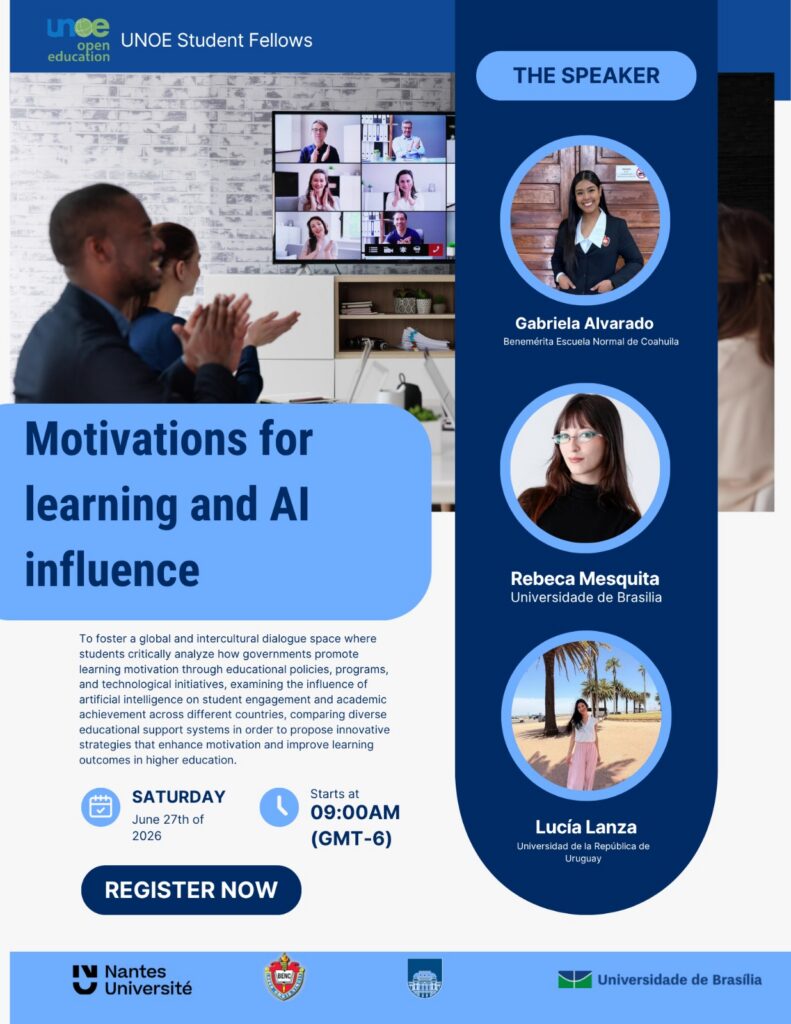
Webinar Development: “Motivations for learning and AI influence”
During the webinar, the relationship between learning motivation and the influence of Artificial Intelligence in educational processes was explored. It was highlighted that AI can become a tool that promotes students’ interest, autonomy, and participation by providing personalized resources, immediate feedback, and new ways of interacting with knowledge. However, the importance of maintaining a conscious and balanced use of technology was also emphasized, ensuring that AI complements personal effort rather than replacing students’ reflection, creativity, or commitment.
One of the main ideas discussed was that motivation does not depend solely on the use of digital tools, but rather on how these tools are integrated into meaningful learning experiences. AI can enhance motivation when it responds to students’ needs, facilitates content understanding, and supports the development of skills that allow learners to become more autonomous and responsible in their learning processes.
Final Reflections: New Challenges and Opportunities in Digital Education
Participation in this event allowed us to broaden our perspective on the challenges and opportunities that emerge from the integration of Artificial Intelligence into educational processes. Through the exchange of ideas and experiences, we understood that educational transformation does not depend only on incorporating new technological tools, but on using them with pedagogical purpose to improve learning experiences.
This experience allowed us to recognize the essential role of teachers as guides in the responsible use of Artificial Intelligence, promoting students’ development of skills such as critical thinking, autonomy, and informed decision-making. We analyzed that AI represents an opportunity to enrich teaching practices, as long as it is accompanied by values, reflection, and a human-centered perspective.
We would like to thank the UNOE Student Fellowship program and everyone who contributed to making this learning and collaboration space possible. We hope that these types of academic encounters continue promoting dialogue about the future of education and the role of technology in creating more innovative and meaningful learning experiences.

“
Motivation and the Influence of Artificial Intelligence on Learning: Perspectives on the Future of Education
” by Gabriela Alvarado is licensed under CC BY 4.0