Category: Student Fellows Project

  • Protecting Rights, Sharing Ideas: A Student-Led Initiative on Open Education and AI at the University of Sousse

    Protecting Rights, Sharing Ideas: A Student-Led Initiative on Open Education and AI at the University of Sousse

    Zeineb Ben Azzouz  is a Tunisian PhD student at the University of Sousse. Her research focuses on adaptive assessment, generative AI, gamification, instructional design, and open educational resources. She is passionate about innovation in education

    Hiba Haj Mahmoud is a first-year doctoral researcher at ISITCom, University of Sousse, Tunisia. She holds a Master’s degree in Artificial Intelligence (2025).Her research focuses on adaptive assessment and AI in collaborative learning environments.

    Rabeb Sayadi is a Master’s student in Artificial Intelligence and Data Analytics at ISITCOM, University of Sousse, Tunisia, where she is affiliated with the Prince Lab research group.She is passionate about AI and emerging technologies, and their potential to transform education and knowledge access. She aspires to pursue a career as an AI researcher.


    Every year, thousands of student theses and dissertations are produced around the world. However, many of these valuable works remain invisible, uncited, and legally unprotected.

    Many students publish their dissertations without any license because they do not know their rights. They often do not know how to share their work while protecting their authorship.

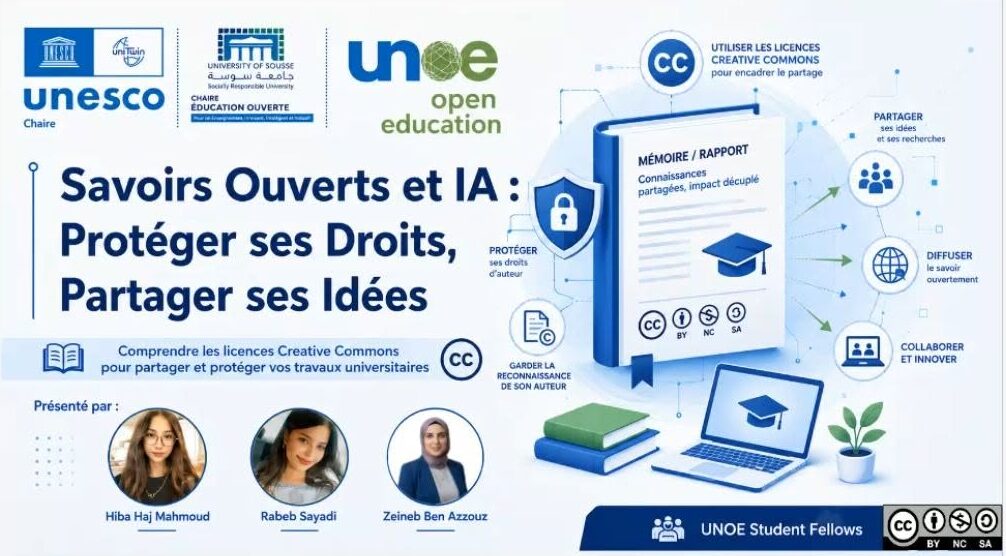
    To address this challenge, three UNOE Student Fellows from the University of Sousse (Tunisia) organized a webinar entitled “Savoirs Ouverts et IA : Protéger ses Droits, Partager ses Idées.” The initiative aimed to raise awareness about Creative Commons licenses, Open Educational Resources, and responsible use of artificial intelligence.

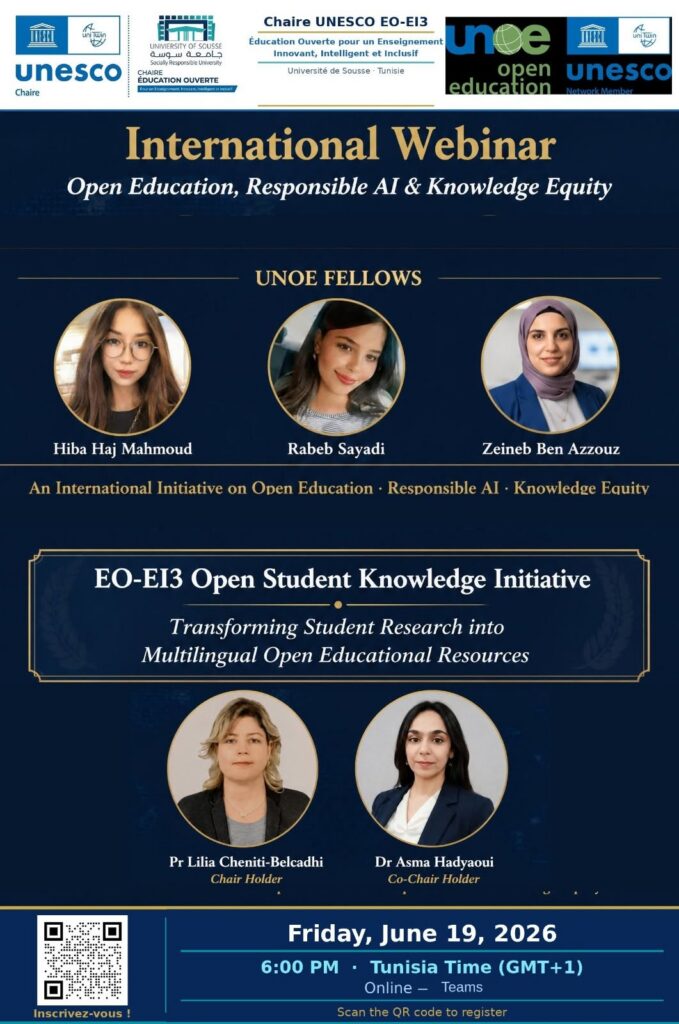
    Webinar announcement poster

    The Webinar: “Open Education, Responsible AI & Knowledge Equity”

    The webinar helped participants discover:

    • Creative Commons licenses;
    • Open Educational Resources (OER);
    • Responsible AI.

    To make these concepts easy to understand, we adopted an active and engaging approach based on:

    • storytelling;
    • real-life examples;
    • interactive questions;
    • practical activities.

    Participants learned that it is possible to share knowledge while keeping control over their work.

    An interactive and practical approach

    One of the strongest parts of the webinar was the practical application. Participants were invited to:

    • Choose a Creative Commons license;
    • Apply it to their own thesis or project;
    • Share their work with others.

    This transformed the webinar into real action.

    We also discussed Open Education and the importance of the 5R principles: Retain, Reuse, Revise, Remix, and Redistribute. Participants discovered how open educational practices can increase access to knowledge and support learning.

    Finally, we explored the relationship between Open Education and responsible AI. In the age of artificial intelligence, openly shared and properly licensed knowledge can help create more equitable and responsible educational systems.

    This initiative showed that students are ready to share their knowledge when they understand their rights and the available tools. In the age of AI, teaching students how to share responsibly may become as important as teaching them how to create.

    Protecting Rights, Sharing Ideas: A Student-Led Initiative on Open Education and AI at the University of Sousse

    ” by Zeineb Ben Azzouz, Hiba Haj Mahmoud & Rabeb Sayadi is licensed under CC BY 4.0

  • Innovating Education with AI and OER: International Dialogue for Transformative Learning

    Innovating Education with AI and OER: International Dialogue for Transformative Learning


    Yaretzy Gabriela Calamaco Munguía is part of the Student Felllows project is studying for a Master’s degree in Pedagogical Innovation and Educational Management at the Benemérita Escuela Normal de Coahuila, Mexico. She is interested in educational innovation, digital technologies and artificial intelligence applied to learning.

    Bringing Together Innovation and International Collaboration

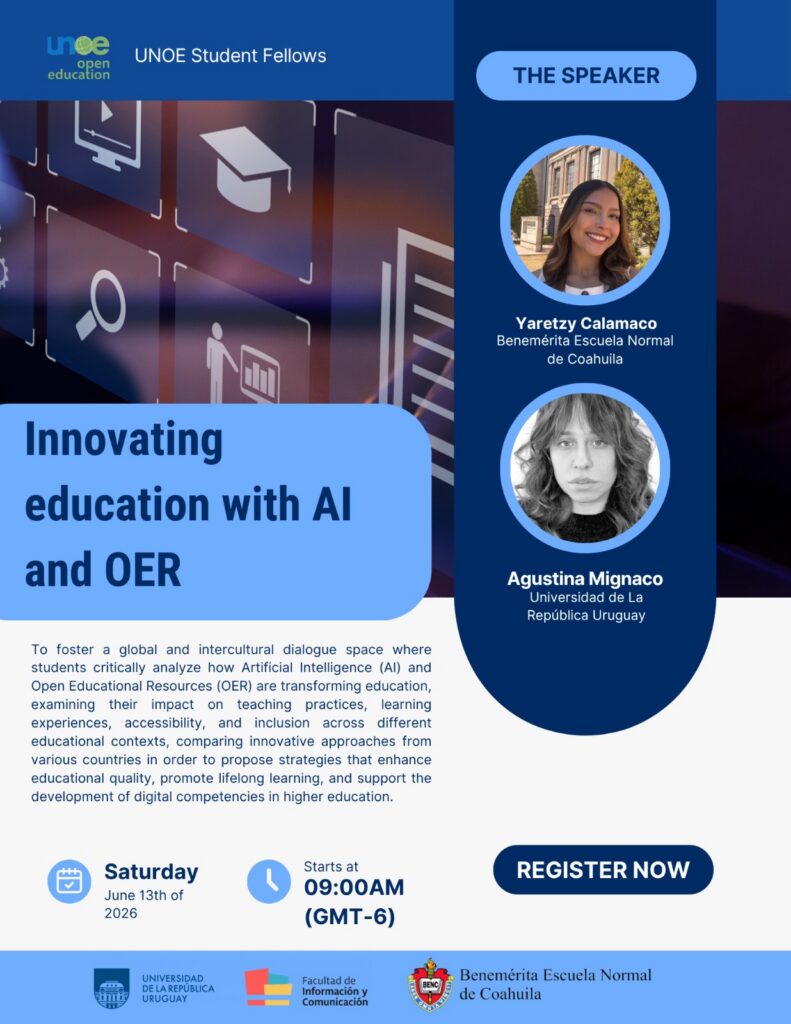
    Innovation in education is born when ideas, people, and technologies come together to reimagine how we learn and teach. A webinar entitled “Innovating Education with AI and OER”, organized by the UNOE Mexico Team Student Fellowship, was held on 13 June 2026 in a virtual format via Zoom, with the participation of approximately 45 attendees.

    The session, coordinated by academic leaders from Mexico and developed in collaboration with international participants from Uruguay, created a meaningful space for academic dialogue on the integration of Artificial Intelligence (AI) and Open Educational Resources (OER) in contemporary education.

    The webinar was led by two student speakers: Yaretzy Gabriela Calamaco Munguía, a master’s student in Pedagogical Innovation and Educational Management at the Benemérita Escuela Normal de Coahuila (Mexico), and Agustina Sofía Mignaco Hernández, a student from the Universidad de la República (Uruguay). Their participation fostered an intercultural exchange of perspectives, enriching the discussion on educational innovation from diverse academic and cultural contexts.

    Webinar announcement poster

    Key Topics and Participant Engagement

    The webinar brought together speakers and participants from diverse educational backgrounds, fostering collaborative reflection between Mexico and Uruguay. Key themes included the pedagogical use of Artificial Intelligence in education, highlighting its potential to support personalized learning, instructional design, and educational innovation, while emphasizing the importance of ethical, transparent, and responsible implementation.

    The discussion also explored Open Educational Resources (OER) as a strategy to promote open access to knowledge, educational equity, and collaborative knowledge creation through open licensing and resource sharing. In addition, Universal Design for Learning (UDL) was presented as an inclusive framework that supports learner diversity through flexible educational experiences adapted to different needs and contexts.

    Participants also reflected on the development of essential digital competencies, including digital literacy, communication, content creation, collaboration, and critical thinking in increasingly technology-mediated learning environments.

    Interactive participation was a central component of the webinar. Through Mentimeter activities, attendees identified key digital competencies for professional development, while a collaborative brainstorming exercise enabled participants to collectively define OER through concepts such as accessibility, inclusion, collaboration, open access, and educational innovation.

    The session was conducted primarily in Spanish, with English subtitles available to support accessibility and international participation, reinforcing its commitment to inclusive and global dialogue.

    Reflections for the Future

    More than an academic event, the webinar became a space for reflection, connection, and shared purpose, where participants exchanged experiences and envisioned more inclusive and innovative educational futures. The dialogue between Mexico and Uruguay highlighted the value of international collaboration in addressing the challenges and opportunities of education in the digital era.

    Ultimately, this experience reminds us that educational transformation is not driven solely by technology, but by the human commitment to learn together, share knowledge, and build more open, equitable, and meaningful learning communities.

    Innovating Education with AI and OER: International Dialogue for Transformative Learning

    ” by Yaretzy Gabriela Calamaco Munguía is licensed under CC BY 4.0

  • Learning About Fair and Ethical Use of Artificial Intelligence in Assessment

    Learning About Fair and Ethical Use of Artificial Intelligence in Assessment

    Yovanna Leija is part of the Student Fellows project. She is studying for a Master’s degree in Educational Innovation and Management at the Benemérita Escuela Normal de Coahuila, Mexico. She is interested in educational research, particularly in areas related to artificial intelligence, ethics and learning.

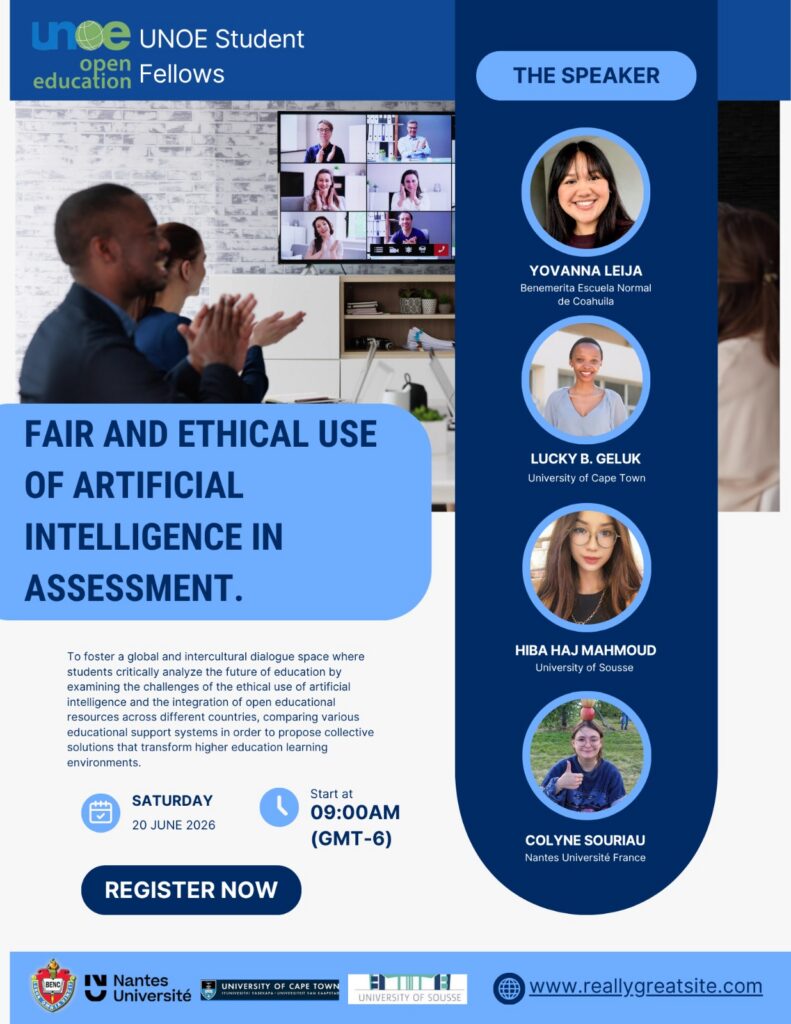
    As student teachers from the Benemérita Escuela Normal de Coahuila in Mexico, participating in the UNOE Student Fellowship has been a valuable opportunity to explore current challenges and opportunities in education. One of the most meaningful experiences of this journey was organizing and hosting the webinar “Fair and Ethical Use of Artificial Intelligence in Assessment.”

    Artificial intelligence is becoming increasingly present in educational environments. While AI offers important benefits, such as personalized feedback, learning support, and assistance with assessment processes, it also raises ethical concerns related to academic integrity, transparency, bias, privacy, and fairness. These issues motivated us to create a space for dialogue and reflection.

    Webinar announcement poster

    Organising the Webinar: “Fair and Ethical Use of Artificial Intelligence in Assessment.”

    During the webinar, we had the opportunity to learn from speakers from different countries and educational contexts. Their perspectives helped us understand that ethical AI use is not only a technological matter but also a human one. Educators, students, and institutions all share responsibility for ensuring that AI is used in ways that support learning while respecting ethical principles.

    One of the key ideas we discussed was the importance of developing clear guidelines and fostering digital ethics. Rather than viewing AI solely as a threat or a solution, we explored how it can be used responsibly to enhance assessment practices and support meaningful learning experiences.

    Beyond the Event: Strengthening Essential Skills

    Organizing this event also allowed us to strengthen our collaboration, communication, and leadership skills. Working with an international audience and engaging in conversations about global educational challenges reminded us of the importance of intercultural dialogue and collective learning.

    This experience reinforced our belief that the future of education will require not only technological knowledge but also ethical awareness. As future educators, we recognize the importance of promoting responsible AI use and helping students develop the critical thinking skills needed to navigate an increasingly digital world.

    We are grateful to the UNOE Student Fellowship, our speakers, and all participants who contributed to this enriching discussion. We hope that conversations about ethical AI in education continue to grow and inspire positive change in teaching and learning.

    Learning About Fair and Ethical Use of Artificial Intelligence in Assessment

    ” by Yovanna Leija is licensed under CC BY 4.0

  • UNOE Student Fellows: Student Voices to Reinvent Education

    UNOE Student Fellows: Student Voices to Reinvent Education

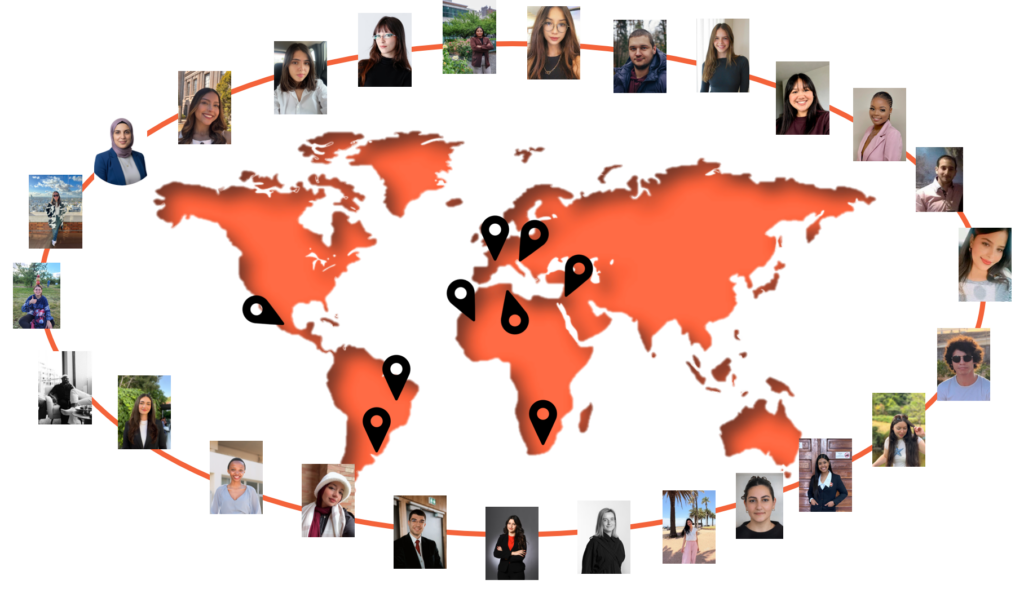
    For the past several months, 26 students from nine different countries have been participating in the UNOE Student Fellows project, organized within our UNITWIN Network on Open Education.

    Build a Global Community of Students

    Supported by a grant from the Hewlett Foundation, the project aims to build a global community of students from the countries where our UNESCO Chairs are based. Together, they engage in discussions and develop new imaginaries about the future of advanced technologies in education and the role that “openness” can play in the future of higher education.

    As project coordinators and Chairs of the network, we deliberately chose to intervene as little as possible in the fellows’ discussions and activities in order to preserve their freedom of expression. This has not always been easy. We have had to learn to trust them, step back, and create a space where ideas can emerge freely, without the influence or oversight of teachers and supervisors.

    26 Fellows, 9 Countries, 7 languages

    Nico Pampier, a student at the University of Cape Town in South Africa, took on the leadership of the group. It is no small challenge, given the nine countries represented, the multiple time zones, and the diversity of languages involved.

    Indeed, seven home languages are spoken across the fellows. While this linguistic diversity inevitably brings challenges, participants consistently make every effort to communicate, collaborate, and engage actively in the monthly meetings and project activities.

    They were given just one instruction: select a topic from the many proposals submitted by the Chairs. Beyond that, the fellows were free to organize their work, discussions, and initiatives as they saw fit.

    Students then organized themselves into small groups of four to six members, each focusing on a shared theme. The result is a set of multinational, multilingual, and multicultural teams whose diversity promises a wealth of perspectives and ideas. We look forward to discovering their final outputs, which are expected by the end of 2026.

    UNOE 26 Student-Fellows. Photomontage. CCBY

    Some Initiatives by the Fellows

    The students, however, did not simply wait for the project to unfold. They quickly embraced the responsibility entrusted to them and launched several initiatives of their own. Today, we are proud to present:

    A first individual deliverable, entitled Rapport d’étonnement (literally, an “astonishment report” – a pedagogical exercise used in France)

    This exercise encourages students to take a fresh and reflective look at education by focusing on something that surprised, intrigued, or challenged them. They are invited to adopt a curious perspective and allow themselves a degree of naivety—whether genuine or intentional—in order to question practices, assumptions, and routines that are often taken for granted.

    These reports explore a wide range of inspiring topics: critical perspectives on the relationship between assessment and learning; questions surrounding the emergence of generative AI and its implications for the future of education; reflections on the challenges of accessing Open Educational Resources (OER); more personal stories on the factors that spark the desire to learn and to succeed.

    Take a moment to refresh your perspective and explore their contributions.

    A great initiative developed by the Student Fellows from Universidad de la República in Uruguay. Discover here the “FANZINE PAVO REAL”, a collaborative project designed to help students around the world discover Open Educational Resources (OER) and learn how to create, adapt, and share their own openly licensed materials.

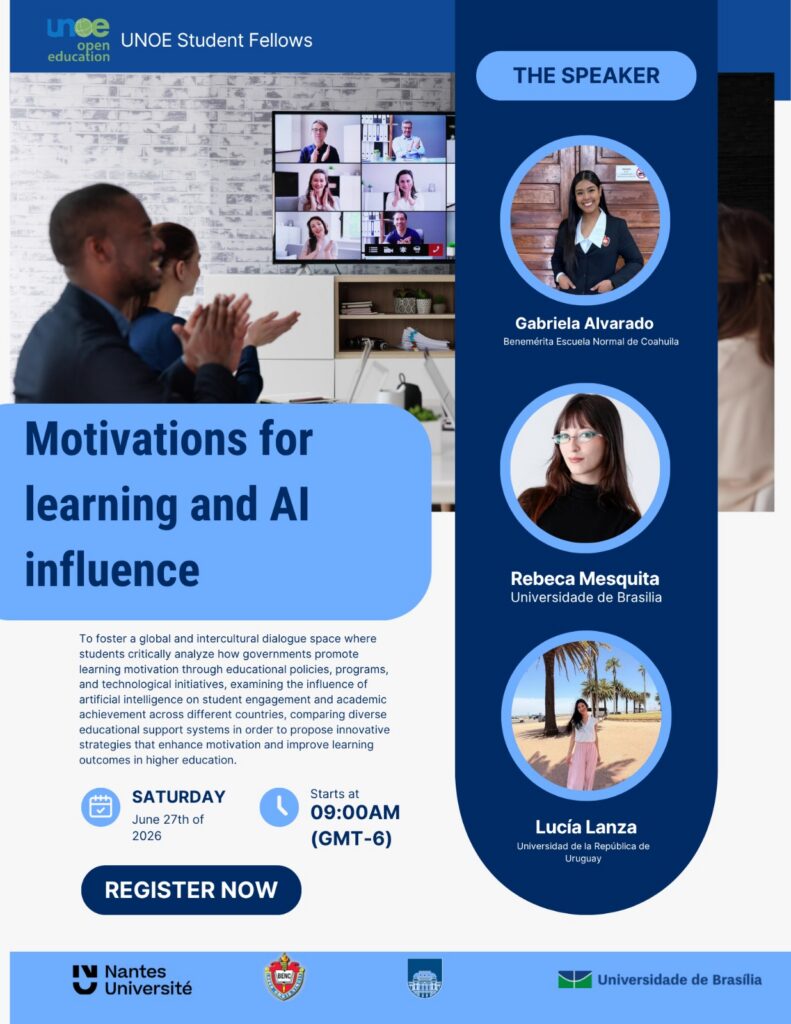
    A series of international collaborative webinars, entitled “Reimagining Learning: Global Student Dialogues for the Future.” The first webinar took place on 13 June, and two more webinars are scheduled for 20 and 27 June (registration link below). These webinars provide an opportunity for students to share their thoughts, experiences and visions for the future of education on a global scale.

    • 13 June 2026: Innovative Education with AI and OER
    • 20 June 2026, 17:00 (CEST): Fair and Ethical Use of Artificial Intelligence in Assessment
    • 27 June 2026, 17:00 (CEST): Motivations for learning and AI influence

    Register here for the webinars

    A webinar by 3 Tunisian Fellows, entitled “Transforming Student Research into Multilingual Open Educational Resources. Mainly aimed at students, the webinar will outline the characteristics of an OER and encourage the students to apply open licences to their final-year dissertations.

    • 19 June 2026, 19:00 (CEST) : Transforming Student Research into Multilingual Open Educational Resources

    Register here for the webinar

    These first achievements already demonstrate the creativity, commitment, and diversity of perspectives brought by the Student Fellows. Through their reflections, initiatives, and exchanges, they are helping to shape a pluralistic and international vision for the future of open education. We look forward to continuing this journey alongside them and to discovering the projects and outcomes that will emerge before the end of 2026.