

Zeineb Ben Azzouz is a Tunisian PhD student at the University of Sousse. Her research focuses on adaptive assessment, generative AI, gamification, instructional design, and open educational resources. She is passionate about innovation in education
Hiba Haj Mahmoud is a first-year doctoral researcher at ISITCom, University of Sousse, Tunisia. She holds a Master’s degree in Artificial Intelligence (2025).Her research focuses on adaptive assessment and AI in collaborative learning environments.
Rabeb Sayadi is a Master’s student in Artificial Intelligence and Data Analytics at ISITCOM, University of Sousse, Tunisia, where she is affiliated with the Prince Lab research group.She is passionate about AI and emerging technologies, and their potential to transform education and knowledge access. She aspires to pursue a career as an AI researcher.
Every year, thousands of student theses and dissertations are produced around the world. However, many of these valuable works remain invisible, uncited, and legally unprotected.
Many students publish their dissertations without any license because they do not know their rights. They often do not know how to share their work while protecting their authorship.
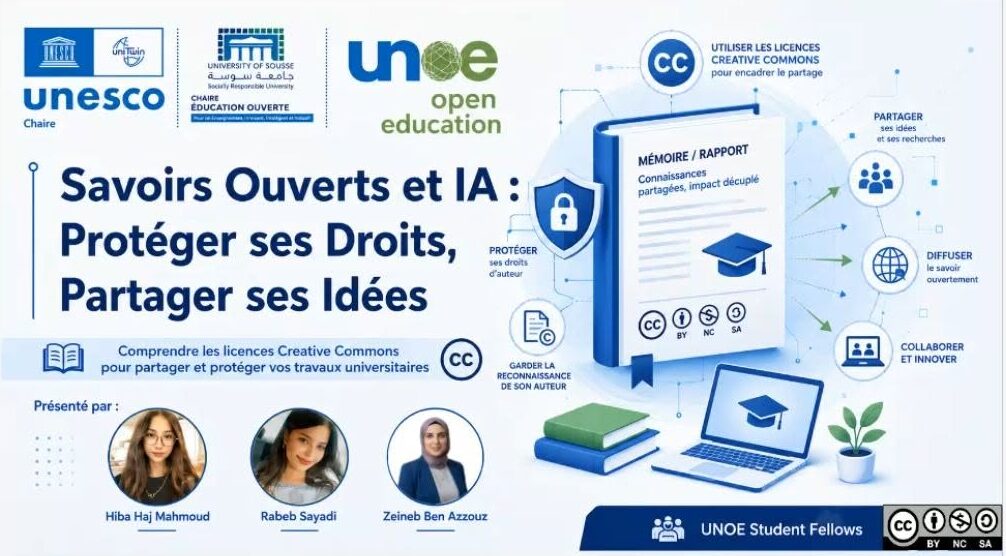
To address this challenge, three UNOE Student Fellows from the University of Sousse (Tunisia) organized a webinar entitled “Savoirs Ouverts et IA : Protéger ses Droits, Partager ses Idées.” The initiative aimed to raise awareness about Creative Commons licenses, Open Educational Resources, and responsible use of artificial intelligence.
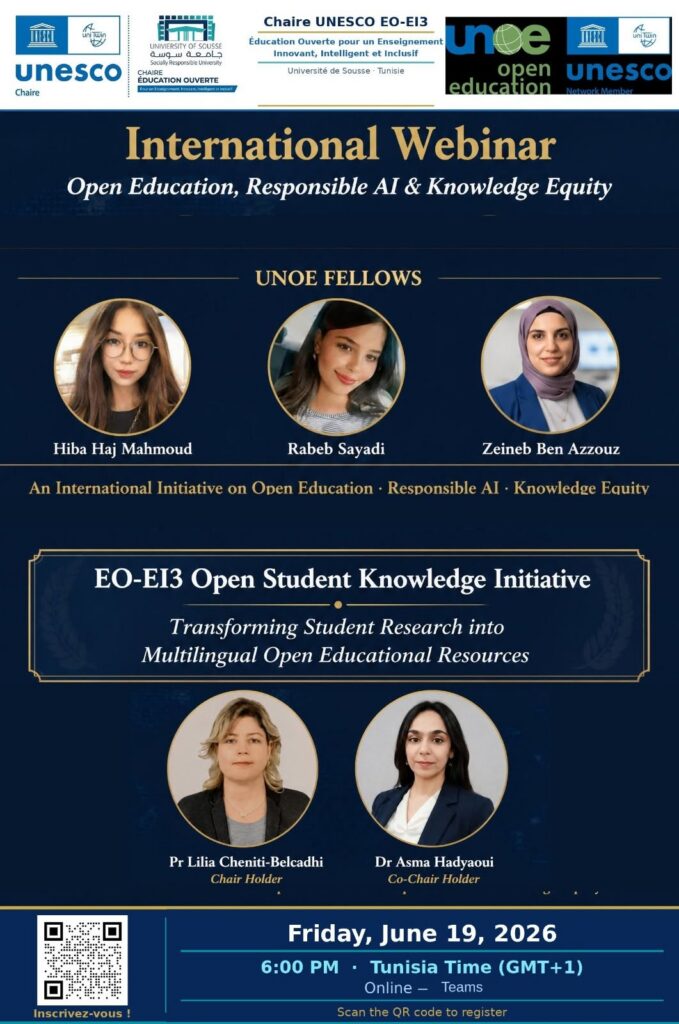
The Webinar: “Open Education, Responsible AI & Knowledge Equity”
The webinar helped participants discover:
- Creative Commons licenses;
- Open Educational Resources (OER);
- Responsible AI.
To make these concepts easy to understand, we adopted an active and engaging approach based on:
- storytelling;
- real-life examples;
- interactive questions;
- practical activities.
Participants learned that it is possible to share knowledge while keeping control over their work.
An interactive and practical approach
One of the strongest parts of the webinar was the practical application. Participants were invited to:
- Choose a Creative Commons license;
- Apply it to their own thesis or project;
- Share their work with others.
This transformed the webinar into real action.
We also discussed Open Education and the importance of the 5R principles: Retain, Reuse, Revise, Remix, and Redistribute. Participants discovered how open educational practices can increase access to knowledge and support learning.
Finally, we explored the relationship between Open Education and responsible AI. In the age of artificial intelligence, openly shared and properly licensed knowledge can help create more equitable and responsible educational systems.
This initiative showed that students are ready to share their knowledge when they understand their rights and the available tools. In the age of AI, teaching students how to share responsibly may become as important as teaching them how to create.

“
Protecting Rights, Sharing Ideas: A Student-Led Initiative on Open Education and AI at the University of Sousse
” by Zeineb Ben Azzouz, Hiba Haj Mahmoud & Rabeb Sayadi is licensed under CC BY 4.0