

Participating in UNESCO’s Digital Learning Week 2026 in Paris was an experience that meant much more to me than presenting research at an international academic event. It represented an opportunity to step outside the usual spaces where I develop as a teacher and researcher and to meet people, ideas, and educational realities that are very different from those I know. At the same time, experiencing this opportunity alongside my colleagues gave the learning a collective meaning, as each of us arrived with our own research, perspective, and academic journey, yet we shared the opportunity to learn and participate in the same international space.
This opportunity was made possible thanks to the support of the Benemérita Escuela Normal de Coahuila and the UNOE project, as well as the work and guidance of Dr. María Soledad Ramírez Montoya, coordinator of the project in Mexico, who guided and supported us throughout its different stages. Her support was essential in helping us arrive at this space with the necessary preparation, but also with the confidence to recognize ourselves as young researchers capable of contributing to international conversations about education, technology, and the future of learning. For me, this support also represents an example of the importance of educational institutions when they create opportunities for their students to move beyond the classroom and bring their knowledge into other spaces.
Even before Digital Learning Week began, we started experiencing this journey as a team. On the Monday before the opening, we had a preparation meeting with the project coordination team, where we were able to gain a clearer understanding of the activities we would be involved in and prepare for our participation. From that moment, I began to understand that this was not simply about traveling to Paris to present a research project, but about becoming part of an international community in which we would have the opportunity to listen, engage in dialogue, and learn from other people, institutions, and contexts.
During Digital Learning Week, we attended the opening conference and different sessions related to artificial intelligence, digital transformation, open education, equity, ethics, digital sovereignty, and the futures of education. What particularly caught my attention was that conversations about artificial intelligence did not focus solely on its technical possibilities. Instead, they repeatedly returned to questions about people and the purpose of education: What role do we want these technologies to play? How can we ensure that their benefits are accessible to different communities? What principles should guide their integration? And, above all, what do we want to preserve in education as we transform the way we learn?
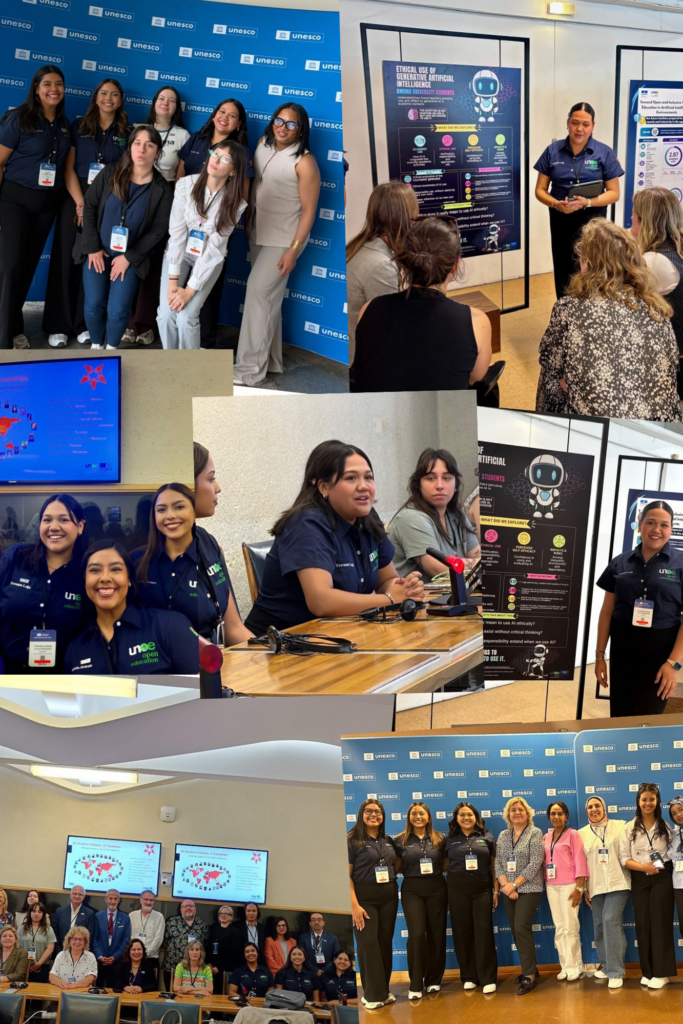
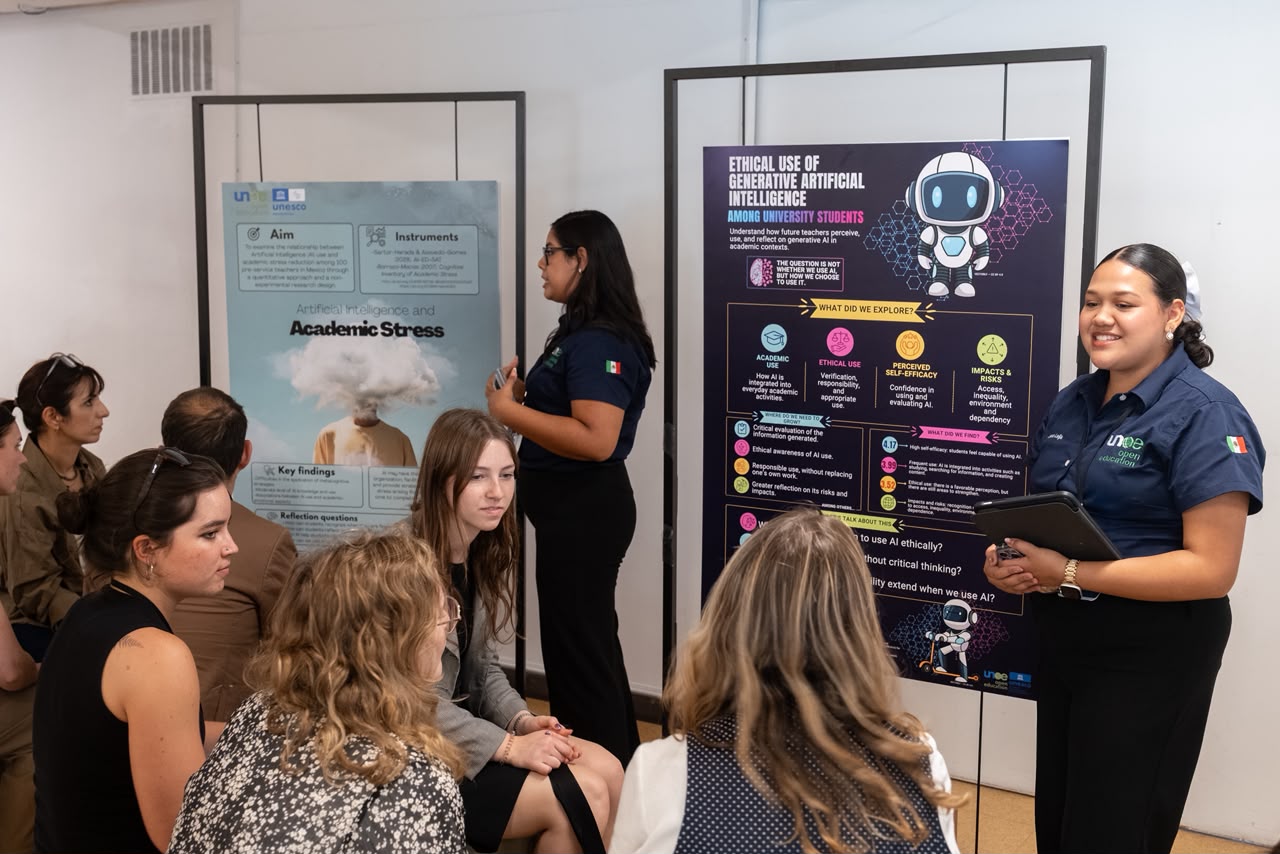
These questions were also present in our own participation, especially during the Living Gallery, where we had the opportunity to share our research over two days. On Tuesday, we presented our work in English, and on Thursday, we shared it again, this time in Spanish, together with Agustina Mignaco, Rebeca Mesquita, Gabriela Alvarado, Yaretzy Calamaco, and myself, Yovanna Leija.
The Living Gallery format was different from a conventional academic presentation. Instead of giving an extended presentation in front of an audience, we welcomed small groups of participants who approached our space to learn about our research for approximately three minutes. The groups would then rotate, and we would begin the exchange again. At first, I thought three minutes would be far too little time to explain a research project. However, as the rounds progressed, I discovered that this limitation actually made the experience much more dynamic. Each group arrived with different interests, experiences, and questions, so we could not simply repeat exactly the same speech.
We had to listen, observe, and find the best way to connect our research with the person in front of us. This made every round a different experience. In my case, this led me to reflect on how communicating research also means learning to translate our ideas without losing their depth, while making sure they can be understood and discussed by people who may not belong directly to our field of study.
For me, this was one of the experiences that best represented the value of dialogue within open education. Sharing knowledge did not simply mean transmitting information; it meant allowing others to ask questions, contribute their own experiences, and help us view our research from different perspectives. Presenting research related to artificial intelligence, ethics, open education, and new generations took on a special meaning when doing so in front of people from different parts of the world. Each conversation allowed us to recognize both the particularities of our own contexts and the concerns we share.
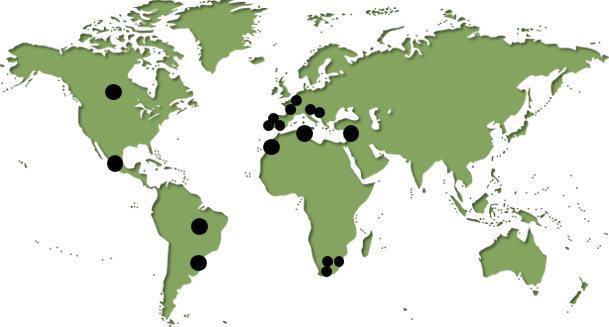
During these encounters, we had the opportunity to speak with participants from Tunisia, Kenya, Romania, England, Brazil, and other places. Although our educational realities were different, we found common themes related to access to technology, teacher education, digital inequalities, ethics in the use of artificial intelligence, and the need for technological transformations to genuinely respond to educational and social purposes. This diversity of perspectives helped me understand that many of the challenges we observe within our own contexts are part of much broader conversations, in which each region contributes particular experiences that can enrich the global discussion.
In addition to the formal presentation spaces, we had many spontaneous conversations throughout the week, some brief and others that lasted much longer than expected. On several occasions, we began by talking about our research and ended up sharing experiences about our institutions, our countries, our projects, and even our ideas for the future. In fact, some of these conversations led to possible collaborations that we hope to continue developing later on. This allowed me to recognize that an international experience does not end when a conference comes to an end. Often, it is precisely through these encounters that new possibilities begin to emerge.
As a result of these interactions, my understanding of open education also changed. Before, I mainly associated it with access to knowledge, educational resources, and the possibilities that technologies offer for sharing information. After this experience, I began to see it also as a willingness to meet others, listen to different perspectives, and build knowledge collaboratively. The Living Gallery allowed me to experience this in a very concrete way. Every time we explained our research, we also opened it up to new questions. Sometimes, a participant would offer a perspective we had not considered or connect our work with an experience from their own context, making knowledge no longer something static, but something that could be enriched through dialogue.
Another lesson I take from this experience is the value of participating as a student and researcher in training within an international space. Sometimes, we may think that we need an extensive academic trajectory before feeling that we have something to contribute to an academic conversation. Being at UNESCO allowed me to question this idea and understand that research developed within our own contexts can also generate questions, interest, and connections with people from other parts of the world.
For me, it was especially meaningful to share work that emerged from my educational reality in Mexico, because in every conversation I also carried with me part of my teacher education and what I have learned at BENC. For this reason, I believe that this experience not only strengthened my academic development, but also my sense of belonging to the institution that made it possible for me to be there. At the same time, experiencing this journey alongside my colleagues was fundamental. We shared our nervousness before presenting, prepared together, listened to each other’s research, and, after each day, discussed what had happened during the different conversations. In this way, learning was also constructed through our experience as a team.
The experience also led me to reflect on the responsibility we have as people who are being trained in the field of education. At a time when artificial intelligence is rapidly transforming the ways in which we learn, teach, conduct research, and produce knowledge, I believe it is not enough to ask what technology can do. We also need to ask who it is developed for, what purposes it serves, who can access it, and under what principles we want to incorporate it into education. From this perspective, technological innovation should not be understood merely as the incorporation of new tools, but as an opportunity to question and build better ways of learning and teaching.
Digital Learning Week did not leave me with definitive answers to all these questions. Instead, it left me with new questions, new connections, and new possibilities. I believe that this is precisely one of the greatest lessons an open education space can offer: understanding that learning does not always mean finding answers, but rather expanding the questions through which we observe our reality.
Upon returning home, I am left with much more than the satisfaction of having participated in an international event. I carry with me the conversations, the people we met, the ideas we shared, and the possibilities that emerged from those encounters. I also carry the certainty that research can become a bridge connecting very different educational realities and that, when we open our knowledge to dialogue, we also open the possibility of transforming it. This experience became even more meaningful when I connected it with the purpose of Digital Learning Week itself, which in its 2026 edition sought to keep human agency, equity, and the public purpose of education at the center of educational futures in the face of the expansion of artificial intelligence (UNESCO, 2026).
Acknowledgments. This experience took place within the framework of the UNOE Student Fellows Project, funded by the William and Flora Hewlett Foundation and coordinated by Nantes Université. We acknowledge the support provided to promote educational training, research, and innovation through open education. We also recognize the Benemérita Escuela Normal de Coahuila for its institutional support and for promoting the development of research competencies.