


Reflections from UNESCO Digital Learning Week 2026
Some experiences begin long before arriving at the place where they take place.
My experience participating in UNESCO’s Digital Learning Week 2026 began with an invitation from Dr. María Soledad Ramírez-Montoya, head of the UNESCO Chair on Open Educational Movement for Latin America, for Master’s students from the Benemérita Escuela Normal de Coahuila (BENC) to participate in the UNOE Fellowship Program. The directors and a team of BENC faculty members placed their trust in my colleagues and me and considered us for the Fellowship Program, which gave us the opportunity to take part in this international experience that would eventually take us all the way to Paris. Behind our participation were guidance, support, and, above all, the opportunity to become part of a community committed to open education, collaboration, and the collective construction of knowledge.
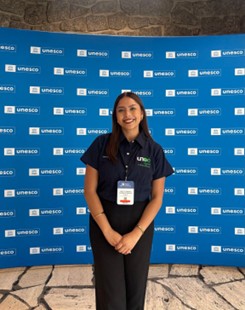
An experience that, until then, had seemed distant, almost like one of those events we observe from afar and assume belong to other places, other people, and other realities. And yet, there we were, in Paris, taking part in UNESCO’s Digital Learning Week 2026.
For a primary school teacher in Mexico and a current Master’s student, arriving at an international space of such magnitude represents much more than travelling from one country to another. It also means crossing an intellectual boundary and discovering that what happens every day in our classrooms is part of much broader conversations about the future of education. Perhaps that is why, as I listened to the different presentations and interventions, I could not help but feel like a small boat navigating through new horizons.
It was not a feeling of smallness as a synonym for inability, but rather an awareness of standing before an immense ocean. An ocean of knowledge, research, experiences, projects, questions, and possibilities that extended far beyond what I had previously been able to imagine.
This experience was made possible by the fellowship granted by the William and Flora Hewlett Foundation, coordinated by the University of Nantes, which enabled our participation in UNESCO’s Digital Learning Week 2026 in Paris. More than financial support, that fellowship represented a gateway into an international space where we were able to listen, engage in dialogue, and share our own educational experiences.
Artificial Intelligence and the Question of Humanity
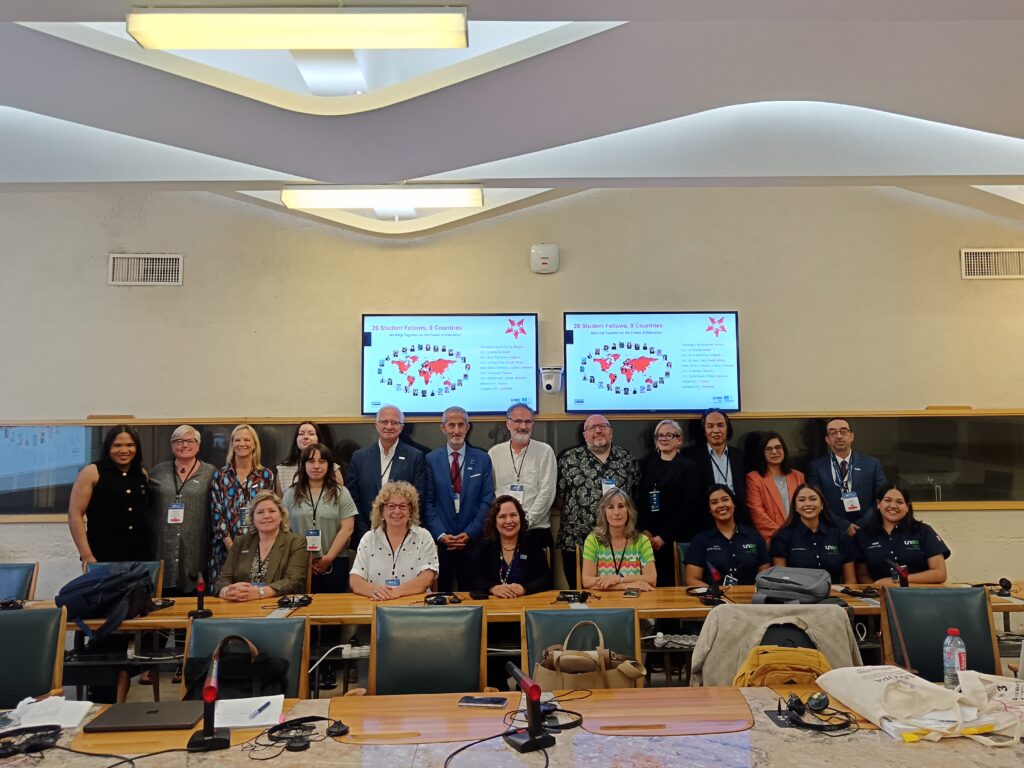
We had the honor of attending and participating in a meeting with the UNESCO team and the UNOE Fellowship Program, where the results and experiences of the work carried out throughout the program were shared, along with projects related to UNITWIN and the UNESCO Chairs. The meeting provided an opportunity to exchange ideas, questions, and perspectives among participants from different contexts, while also allowing us to gain a broader understanding of the initiatives, programs, and work plans being developed in collaboration with institutions, educators, and researchers.
Artificial intelligence was at the heart of many of the conversations, but rather than finding only fascination with technology, I encountered something I consider far more important: questions. Questions about ethics, access, equity, teacher education, design, costs, and infrastructure questions that allowed us to consider artificial intelligence not only in terms of its possibilities, but also in terms of the conditions required for its integration into education to be responsible, relevant, and genuinely inclusive. Questions about the capacity of educational systems to adapt and about the place we want artificial intelligence to occupy in our societies. Talking about AI in education cannot be reduced to asking which tool to use or which platform to adopt. The discussion is much deeper than that.
If artificial intelligence can produce information, then we must strengthen our ability to analyze it. If it can generate content, we need to educate people who are capable of questioning it. If it can automate certain processes, we must ask ourselves which tasks are worth automating and which require precisely those qualities that make us human: judgment, empathy, creativity, interaction, and an understanding of context.
That is why, when I think about the future of education, I do not imagine a school replaced by technology. I imagine a school where technology can expand human possibilities without displacing the essence of the educational act.
From Open Resources to Open Communities
This experience also strengthened a conviction that has accompanied my work: knowledge becomes more valuable when it can be shared, transformed, and placed at the service of others.
This idea is deeply connected to my own research, Toward Open and Inclusive Teacher Education in Artificial Intelligence Environments: A Cross-Sectional Descriptive Correlational Study, in which I analyzed competencies related to open education among pre-service teachers, particularly regarding inclusive access to knowledge and Open Educational Resources (OER). Through this study, I explored dimensions related to capacity building, policies, inclusive access, sustainability, and cooperation, seeking to understand the extent to which these competencies are present among those preparing to enter the teaching profession.
During UNESCO’s Digital Learning Week 2026, many of the conversations I witnessed directly resonated with these concerns. I attended sessions as a listener such as Curriculum and Learning Design in the Age of AI, where discussions focused on how to teach about AI, how to teach with AI, and how to rethink learning design; Putting Teachers in the Lead: Designing AI Tools from Classroom Realities, which placed teachers’ experiences and needs at the starting point for the design of AI tools; and Where Frameworks End and Teaching Begins, which encouraged reflection on the distance between conceptual frameworks and the complexity of educational practice. These discussions led me to reconsider teacher education once again: it is not enough for future teachers to become familiar with new technologies; they need to develop the criteria to decide how, when, and for what purpose to use them.
I also attended discussions related to Strengthening Gen AI Responsiveness for University Teachers: Framework and Cases and Transforming Higher Education in the Age of AI: Mapping the Issues, which broadened my perspective on the challenges that artificial intelligence poses for institutions, teacher education, and teaching and learning processes. In particular, the session Frugal AI for Equitable Learning: Small Models, Offline Solutions, Wider Access made me reflect on an issue closely connected to open education: innovation loses part of its meaning if the conditions required to access it remain profoundly unequal. The discussion around small models and solutions capable of functioning even in contexts with limited connectivity showed that equity must also be considered as part of technological design.
All these conversations found a point of connection with my research. If artificial intelligence is transforming the ways in which knowledge is produced, accessed, and shared, then it is essential to strengthen teachers’ competencies so that they can participate critically in these processes. Within this context, Open Educational Resources acquire particular relevance: it is not simply about finding materials that are freely available, but about understanding their conditions of use, open licenses, possibilities for adaptation and redistribution, and, above all, the responsibility involved in sharing knowledge.
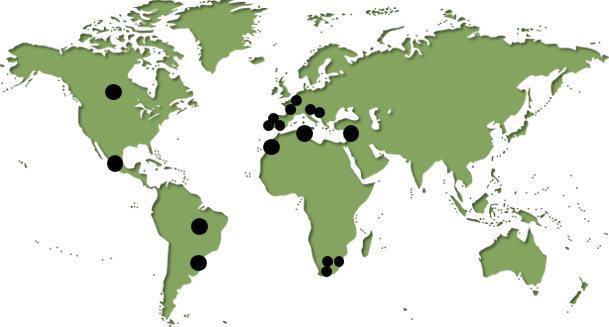
In addition, I had the opportunity to work and spend time with colleagues from different contexts, including Uruguay, Nantes, Brazil, Saudi Arabia, and Mexico. Some of us were able to meet in person in Paris, while others, although unable to attend physically, continued participating and collaborating in the different activities. This experience made tangible for me something I had encountered so many times in theory: an open community can be built beyond borders and physical presence. It can emerge when different people contribute their knowledge, experiences, and perspectives to build something together.
For this reason, my experience in Paris led me to move from thinking about open resources to thinking about open communities. An OER can be a starting point, but it is collaboration that allows knowledge to travel, adapt to other contexts, and generate new possibilities. And perhaps one of the greatest lessons I take from this week is the realization that educational transformation does not occur only within major institutions or international organizations. It also emerges from classrooms, from a teacher who shares a strategy, from a student who discovers a new way of learning, from research that identifies a problem, and from a community that decides to bring together what it knows.
Opening knowledge, then, also means opening pathways. And perhaps that is what I take with me most from this experience: the certainty that we do not need to navigate alone. We can share maps, build networks, and learn from those who are navigating from other places. Because when an experience, a research project, or a resource is shared, it no longer belongs solely to the person who created it; it becomes part of a community capable of transforming it and carrying it much farther.
What I Bring Home to Share
An important part of this experience was listening to and learning about proposals that demonstrate different ways of incorporating technology and artificial intelligence into education. Among the sessions that particularly caught my attention were:
“The UNESCO AI Competency Frameworks in Practice,” which provided an opportunity to learn how artificial intelligence competency frameworks can be translated into educational practice and guide the development of capacities among teachers and students.
“Human-Centered AI for Inclusive Education,” a proposal that placed people and inclusion at the center of discussions on the use of artificial intelligence in education, highlighting the importance of designing solutions that respond to real educational needs.
“Expanding Access to Personalized Feedback Through Simulation-Based Learning,” which presented possibilities for expanding access to personalized feedback through simulation-based learning experiences.
“Gamification Platform Built by Teachers Using AI for Environmental Action,” where we learned about the Eco-In Project, an initiative developed by Korean primary school teachers who integrated gamification and artificial intelligence to address environmental issues and encourage students to participate in environmental actions. I found it particularly meaningful to see how a proposal created by teachers from within the classroom can become an innovative experience with the support of technology.
“Making Climate Education Tangible Through Microclimate Adaptive Learning,” which explored new ways of bringing climate education closer to students through experiences connected to their surroundings and to microclimatic conditions.
These were only some of the many proposals I had the opportunity to listen to throughout the week. Each one showed, from a different perspective, that educational innovation does not depend solely on incorporating new technologies, but on finding meaningful and appropriate ways to use them in response to concrete needs. These are experiences that I want to carry with me on my return to Mexico, continue exploring, and share with educational communities through the lessons I have learned and the insights I have gained.
The Small Boat
There were moments throughout this experience when I inevitably returned to the image of a boat. A small boat facing an enormous horizon. That is how I felt while listening to specialists from different parts of the world speak about issues that, although they are part of my academic interests, I was only beginning to understand from other perspectives. Each panel, each research project, and each conversation seemed to expand that horizon a little further. There were new questions about artificial intelligence, education, curriculum, assessment, teacher education, access to knowledge, and, above all, about the paths we need to build so that digital transformation can also become a more open and inclusive educational transformation.
But there was a moment when that boat ceased to be merely a metaphor for observing the world and became an opportunity to set my own knowledge in motion: sharing my research.
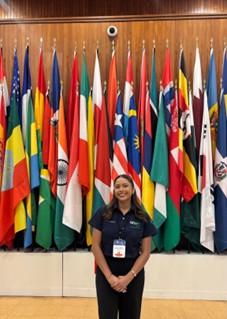
Presenting my work in an international setting was a deeply meaningful experience. Behind that presentation was also the guidance and trust of a team of doctors who made this journey possible, encouraging and supporting me as I brought to Paris research that was born from my own context of teacher education in Mexico, at BENC. Explaining one’s own research to people from different contexts has something about it that compels you to look again at what you believe you already know.
When we present our work, we expect questions about methodology, results, or the decisions we have made. But some questions do something deeper: they make us question ourselves. Each question opened up a possibility. Some made me think about aspects I had not initially considered; others allowed me to find points of connection with different research projects and experiences; and some gave rise to ideas that may strengthen future stages of my work. Through this exchange, I understood that research does not mean constructing definitive answers, but entering into conversation with other perspectives so that our own ideas can continue to evolve.
And it was precisely through these conversations that open education acquired an even more concrete meaning for me. While discussing my research, I was able to observe something that I consider particularly relevant: not everyone involved in education has an in-depth understanding of what Open Educational Resources are, what it truly means for a resource to be open, or what conditions are necessary to share, adapt, and reuse educational materials.
Some conversations even began with the realization that a resource that is freely available on the internet is not necessarily an Open Educational Resource. This may seem like a simple distinction, but in reality, it involves a deeper understanding of knowledge and the ways in which it can circulate.
Talking about OER also means talking about open licenses, copyright, possibilities for reuse and adaptation, and the different ways in which a resource can be made available to others. It means understanding that openness is not limited to free access, but is connected to the conditions that allow knowledge to be legally and responsibly used, transformed, and shared.
These conversations also led me to remember the international recommendations that have promoted open education and, particularly, the importance UNESCO has placed on Open Educational Resources as a means of fostering more equitable access to knowledge, strengthening the capacities of teachers and students, and promoting cooperation and the exchange of resources.
Realizing that some of these ideas were still not widely known led me to an important reflection. Perhaps one of the tasks ahead of us is not only to create more resources, but also to strengthen the culture that enables people to understand, use, adapt, and share them. Because it is not enough to open a resource if those who could benefit from it do not know that it exists, do not know how to use it, or are unaware of the conditions under which they can modify and share it again.
Open education, then, also requires education and training. It requires literacy around licensing, knowledge of copyright, and digital competencies, but above all, it requires a culture of collaboration. And this is where I found a particularly powerful connection with the conversations about artificial intelligence that permeated the week.
At a time when artificial intelligence is transforming the way we produce, search for, and share knowledge, understanding what it means for content to be open becomes even more important. Technological possibilities can greatly expand our capacity to create and distribute educational materials, but they also compel us to ask questions about authorship, sources, licenses, quality, and the conditions under which these materials can be reused.
For this reason, leaving my presentation with new questions was perhaps one of the most valuable lessons of the experience. As the sessions progressed, that initial feeling began to transform. The boat was still small. The ocean was still immense. But now I knew that there were more routes, more ports, and more possibilities for navigation.
I understood that I did not need to know the entire ocean in order to begin exploring it. I needed to be willing to listen, ask questions, learn, and share the journey with others. Sometimes, professional growth means precisely accepting that we still have much to learn. The international experience did not diminish my certainty about what I know; it broadened my awareness of everything I still want to discover.
And that awareness became motivation. Motivation to conduct further research, to read more, to ask questions, to experiment, and to strengthen my professional development. Motivation to continue exploring open education and Open Educational Resources, but also to return to my own context and ask myself what I can do with everything I heard, saw, and felt.
Because I did not want Paris to remain merely as a beautiful memory. I wanted what I had learned to return home with me. I wanted the questions to travel back. I wanted the conversations to become actions. I wanted shared knowledge to find new spaces and the experiences I had the opportunity to live to somehow become opportunities for someone else.
And perhaps that is when I understood something essential about open education: opening knowledge also means opening ourselves to the possibility of learning from others. A resource can be shared, research can be discussed, an idea can be transformed, and a question can travel from one country to another. When this happens, knowledge no longer remains in a single place; it begins to build community.
That is why, today, I look once again at that image of the small boat. I no longer see it standing still before an unknown ocean, but navigating through it, aware that there are still many routes left to discover. We need the willingness to learn from those who have already travelled some of its waters, to share our own experiences, and to build, together, new routes toward a more open, inclusive, and collaborative education.
Because when we discover a new route, perhaps our greatest responsibility is not to keep it for ourselves, but to leave it open so that someone else can travel it.
The Journey Continues
I returned from Paris with new questions and insights about the challenges and opportunities facing education in the context of artificial intelligence, open education, and digital transformation. UNESCO’s Digital Learning Week allowed me to encounter different perspectives, share my research, and recognize the value of collaborating with teachers, students, and researchers from diverse contexts. I now return to Mexico with new ideas to continue learning, researching, and sharing the findings and lessons from this experience with educational communities, while also bringing them into my own educational practice. The journey ends, but the work continues.
Acknowledgments. This experience took place within the framework of the UNOE Student Fellows Project, funded by the William and Flora Hewlett Foundation and coordinated by the University of Nantes. I am grateful for the support provided to promote teacher education, educational research, and innovation through open education. I also acknowledge the Benemérita Escuela Normal de Coahuila for its institutional support and for promoting the development of research competencies.

“
A Small Boat Facing New Horizons
” by Yaretzy Gabriela Calamaco Munguia is licensed under CC BY 4.0