

By Nour Semaan, Notre Dame University Louaize, Lebanon
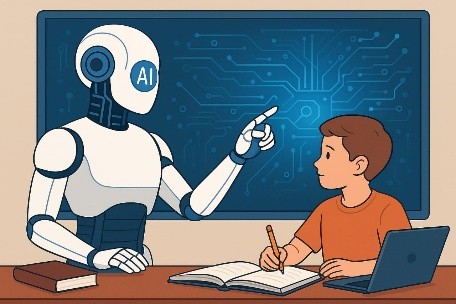
When I first began using Artificial Intelligence tools, I thought of them as advanced search engines. Today, I am astonished by something much larger: AI has quietly become an active and prominent participant in education. It is not a teacher, not a student, and not a textbook. Yet its influence governs all three.
The real surprise, however, is the speed at which AI usage has grown over the last few years.
For decades, schools all around the world struggled to integrate technology meaningfully. Computers were often limited to computer labs, and many digital tools remained supplementary. Then, within a few years, AI systems became capable of answering questions, explaining concepts, generating essays, creating lesson plans, translating languages, and even providing personalized tutoring. Suddenly, every student with an internet connection had access to a private tutor available twenty-four hours a day, whose knowledge is vast and diverse.
This new technological era is both exciting and quite intriguing.
AI offers endless opportunities for learners of all backgrounds—whether it is the curious student eager to learn more, someone struggling with a specific subject, or even a person learning simply for enjoyment. For many people, especially those who lack access to expensive tutoring, AI can make learning more accessible than ever before.
Yet another aspect astonishes me even more.
Education has traditionally rewarded the ability to find information and reproduce it. AI now challenges this model completely. If a machine can generate a summary in seconds, what should students actually learn? If an essay can be drafted instantly, what is the purpose of writing assignments? If answers are always available, how do we teach curiosity, judgment, and critical thinking? The more I think about these questions, the more I realize that AI is forcing education to confront issues that have existed for a long time. Was the goal of education merely to memorize information, or was it to understand and use it wisely? In this era, the distinction is almost impossible to ignore.
It is also intriguing to look at the unequal relationship students have with these tools. Some learners embrace AI confidently, while others fear using it. Some schools encourage experimentation, while others prohibit it entirely. As a result, two students of the same age may be developing completely different skills for the future.
What surprises me most is how quickly students have adapted to this new reality. In many cases, young people are learning how to use AI faster than schools are learning how to respond to it. Some students use it to brainstorm ideas, explain difficult concepts, or practice languages, while others rely on it to complete tasks without fully understanding them. This creates a fascinating paradox: the same tool can encourage deeper learning or discourage it, depending on how it is used. I find myself wondering whether future classrooms will spend less time teaching students how to find information and more time teaching them how to question, evaluate, and apply it responsibly.
Perhaps this is what fascinates me most. Throughout history, education has adapted to books, calculators, the internet, and smartphones. AI may be the next transformation. Whether it becomes a powerful educational ally or an obstacle depends on how we choose to use it.
In sum, I find it compelling that the newest presence in the classroom is neither a teacher nor a student. It is a creation of technology that is forcing all of us to rethink what learning truly means.
