

By Rebecca D. Bou Doumit, Notre Dame University Louaize, Lebanon
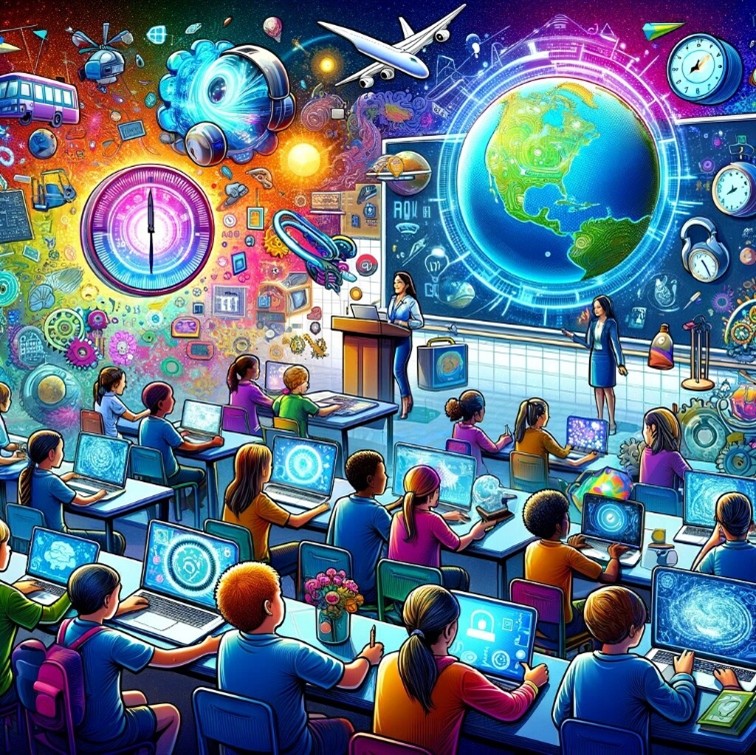
At first glance, this image looks like a classroom, but not the kind most of us grew up with. It is crowded with screens, clocks, ideas, and digital tools. It feels like the classroom has expanded beyond its walls.
Everything around us has been evolving yet most classrooms have not, for centuries, the same class with the teacher standing in front of the students explaining to them a concept. Not taking into consideration how each student learns and thinks and understands. Just one concept taught in one way for all students to understand the same.
In reality, a lot of students struggle with this approach. This has caused a huge wave of demotivation, where the students feel helpless, not being able to understand the concepts taught at school properly. They start to feel embarrassed to ask questions and might feel like they’re the problem, especially since assessments also have become grades based instead of learning based.
Nowadays, with AI, students have access to an infinite amount of information simply by asking a question; they can get a specially tailored answer. Students can now learn anything they want at their own pace and in their own learning style; visually through flashcards, diagrams, and videos, auditorily through spoken explanations, podcasts, and conversational tutoring, kinesthetically through repetitive practicing and testing. This innovation makes the classroom feel less like one path for everyone and more like many paths towards the same understanding.
Personally, I was one of the students who struggled at school; I couldn’t keep up with the teacher in class and the courses always seemed impossible to understand. When I started University, I was worried about facing the same issue but with the emergence of AI I learned how to use it in a way that helps me in my classes and gives me a better understanding of what was being explained in class. By turning my notes into small quizzes and videos to watch I was able to learn more information in less time and finally understood how much joy there is in finally grasping something that used to hold me back.
In the futuristic classroom I chose, every student seems to be following their own curiosity. The laptops and holograms suggest endless opportunities: so many ideas, so many ways of learning, and so many interests being nurtured at once. The teachers stand in a place of guidance, visible but not imposing. Their role feels supportive rather than directive, allowing learners to grow at their own pace.
The clocks scattered across the scene remind me that time is central to education. Growth requires patience, and learning unfolds differently for each person. This astonishes me because it shows a model of education where individuality is respected, guidance is present, and the possibilities are limitless. In the end, this image makes me hope we reach a point where students feel less afraid to ask questions and more excited to learn and grow. AI can open new doors, but education should always stay human at its core with teachers helping students feel capable, supported and curious enough to keep growing. That can make all the difference.
