By Agustina Mignaco, Universidad de la República, Uruguay.
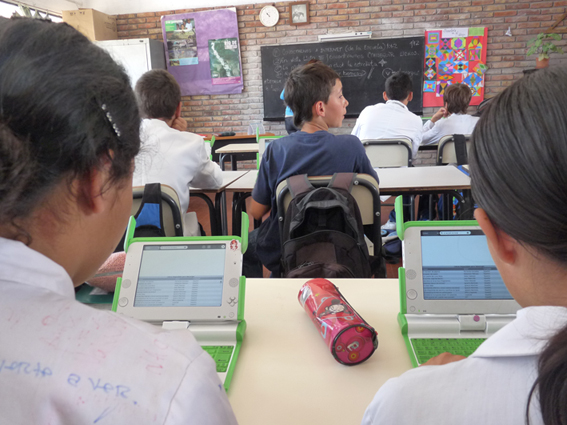
https://commons.wikimedia.org/wiki/File:Estudiantes_con_XO.jpg
Public education in Uruguay has historically been a driving force for social integration, based on the principles of secularism, free access, compulsory education and equal opportunities. In recent years, these principles have been shaped by new dynamics linked to digitalisation and, in particular, the development of open educational resources (OER), which are beginning to play a significant role in the educational ecosystem.
OERs are freely accessible teaching and learning materials that can be used, adapted and redistributed. In Uruguay, their development is linked to policies such as the Ceibal Plan, which promoted digital inclusion and equal opportunities in public education to support educational policies. This not only facilitated access but also the circulation of materials in more open formats.
OERs reinforce a cornerstone of public education: the democratisation of knowledge. Any teacher or student can access materials without relying on paid textbooks or closed platforms, which is particularly important in contexts of economic inequality. Furthermore, the ability to adapt content encourages more tailored teaching practices, allowing materials to be tailored to specific localities and needs.
The incorporation of open educational resources is not without its challenges. One of the main challenges is the lack of specific training for teachers in the use, creation and adaptation of these materials. Although the technology is available, making full and effective use of it depends on pedagogical and digital skills that are not always fully developed. Added to this is the need to ensure the quality of the content, as well as to establish clear criteria for its selection and use in the classroom.
Recent changes in Uruguayan public education, including curriculum reforms and changes to teaching methodologies, have sparked a debate that also affects how OERs are integrated. In some cases, these resources are seen as an opportunity to innovate and diversify educational strategies; in others, as an additional challenge within a system that is already in the process of adapting.
Despite these tensions, the integration of public education and OER represents a significant opportunity to strengthen educational equity. In a context where access to information is currently centralised, promoting open practices not only broadens learning opportunities but also helps to foster more critical and engaged citizens.
Open educational resources are emerging as a key tool within contemporary Uruguayan public education. Their development and consolidation depend not only on technological infrastructure, but also on pedagogical, political and cultural decisions that will define the direction of the education system in the coming years.
Personally, OERs have changed the way I view access to knowledge: I see it as something more open, shared and less constrained by economic factors. In my own environment, they facilitate study and exchange. In the future, their value will lie not only in being open, but also in being truly accessible.
In my own environment, they facilitate study and exchange, especially when it is difficult to access paid materials, and they enable learning in a more autonomous and collaborative way. Looking ahead, I believe their value will lie not only in being open, but in being genuinely accessible – taking into account how they are used and who can benefit from them – so that they do not remain merely a possibility, but become a reality.
