

By Yaretzy Gabriela Calamaco Munguia, Benemérita Escuela Normal de Coahuila, México
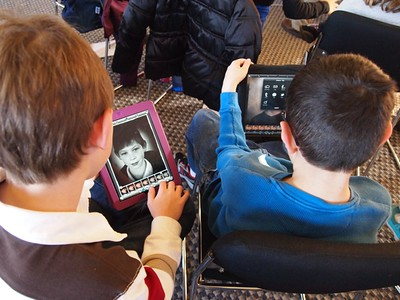
Flickinger in School Technology. Creative Commons Attribution 2.0 (CC BY 2.0) licence.
In an age characterised by constant connectivity and immediate access to information, a question arises that never ceases to amaze me:
how can we educate when attention is constantly divided between multiple stimuli?
What amazes me is not that students use technology. Nor is it that they spend much of their time in front of screens. What really catches my attention is the ease with which they can concentrate for hours on certain digital content and, at the same time, the difficulty they often experience in maintaining their attention on more traditional school activities.
As a student and observer of educational processes, I find this situation fascinating. We have never had so many opportunities to learn. A mobile phone provides access to libraries, courses, educational videos, artificial intelligence tools and content produced anywhere in the world. Knowledge seems to be within everyone’s reach and available at any time.
However, something seems to have changed in our relationship with information. Attention shifts rapidly from one piece of content to another. A notification interrupts a reading session. A message competes with an explanation. One video leads to the next before there is enough time to reflect on the previous one.
The curious thing is that this reality is often interpreted as a lack of interest in learning. My experience leads me to believe otherwise. I see students who are curious, creative and eager to explore topics that spark their interest. I watch them seek answers, resolve doubts and learn new skills outside the classroom. In many cases, they learn on their own initiative, using digital resources that didn’t even exist a few years ago.
This is where the wonder sets in. If students are still learning, what is it that is really changing? Perhaps it is not simply a matter of a shortening attention span. Perhaps we are witnessing a transformation in the way people engage with knowledge.
I am also surprised that much of the educational debate remains focused on deciding whether technology is good or bad for learning. From my perspective, that question seems insufficient. Technology is already part of the daily lives of millions of students. It is present when they search for information, when they collaborate with others, when they create content, and when they discover topics that spark their curiosity.
For that reason, my amazement is not directed at digital tools, but at the changes they are bringing about in the ways we learn, teach and pay attention. Education continues to value deep reflection, careful reading and critical thinking. At the same time, we live in a culture marked by speed, immediacy and a constant flow of information.
I have no definitive answers to this situation. What I do have is a question that continues to haunt me: what will the education of the future look like if attention, one of its most important resources, is changing before our very eyes? Perhaps understanding that transformation is one of the most significant challenges of our time.
