

By Marina Padilha, University of Brasília
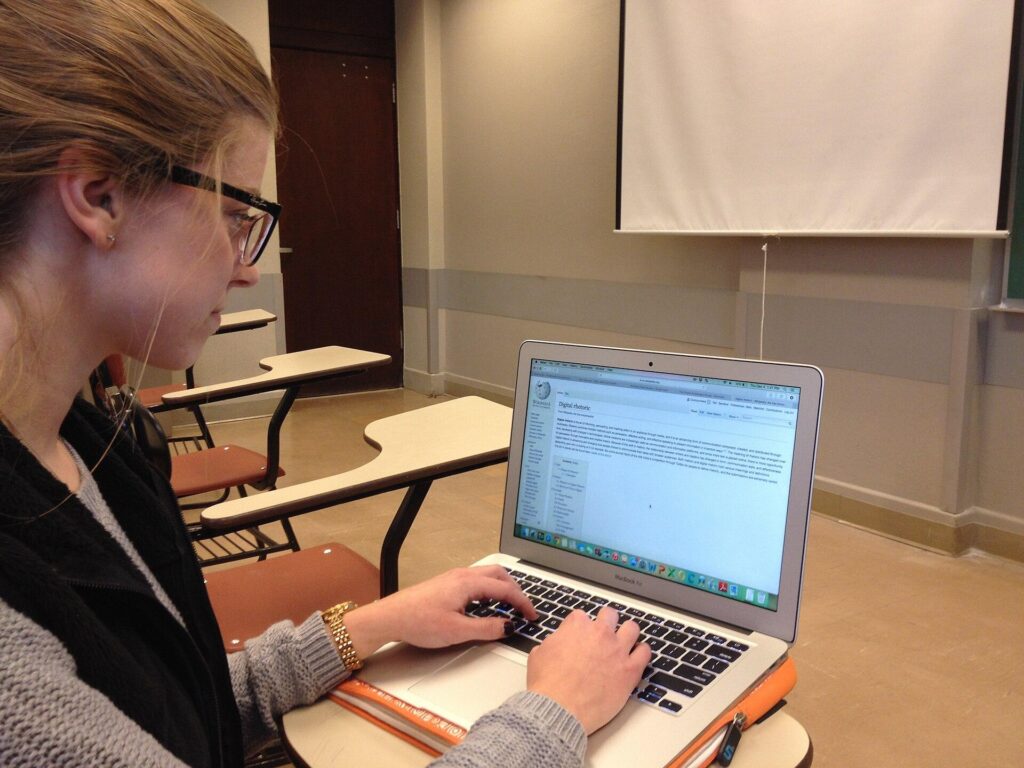
Source: Wikimedia Commons. Available at: https://commons.wikimedia.org/wiki/File:Student_with_computer.JPG
One of the things that made me think most of education nowadays is not the AI itself. What really amazes me is another thing: why do schools and universities still treat the final result as the principal proof that there was learning, if today these results can be produced without real learning?
During a lot of time, handing in a good text, or a good presentation seemed to show that the student had studied, thought, and understood the subject. But now this is not as obvious as it seems. With a little instruction, AI can create great texts and perfect answers. And that changes everything. If the final product doesn’t show what happened in the process, then what exactly is education valuing?
The curious thing about it is that maybe this problem hasn’t started with AI. Maybe it just makes everything more visible. Before these AIs, universities most of the time rewarded those who knew how to do good work. Who knows how to do beautiful work or talk with confidence. But real learning is not always pretty, fast or organized. Learning involves questions, hard work, mistakes, insecurities, and time.
And that’s the reason that amazes me. The AI didn’t create an existing crisis in education alone. It exposes a fragility that was already there: the confusion between performance and learning. As discussed by Jason M. Lodge and Leslie Loble AM in the text Artificial Intelligence, Cognitive Offloading and Implications for Education, published in March of 2026, says about a “performance paradox”, AI can improve the immediate performance of a student in a specific work, but it doesn’t mean that they have had lasting learning. In other words, it can seem that someone was good, and still, doesn’t construct real knowledge.
It makes a lot of sense to me, because learning isn’t just finding a final answer. Learning is passing through the process that teaches you there. When you jump over the process, but the result is still convincing, it’s obvious that the system is more interested in the result than the thinking.
And it worries me that the conversation about AI in education most of the time is limited to the idea of cheating. The problem seems bigger.
It worries me either that the conversation about AI in education sometimes is limited to the idea of “cheating”. The problem seems bigger. It’s not just about making wrong use of the website. It’s about having knowledge that maybe education is just favoring too much what is visible and less what really transforms the student’s education. The same text alerts that the risks aren’t just about producing answers with the help of AI, but interfering in the mental process that constructs knowledge and critical thought.
That’s why, what most astonishes me is not that AI can answer perfectly. What really astonishes me, even now, when answers come so easily, is that education still treats good answers as evidence of learning. Maybe the most important question today is not how to prohibit AI, but how to go back to valuing the processes of learning.
