

March 31st. Open Education Month is drawing to a close. We’ve decided to make the most of it, right up until the very end.
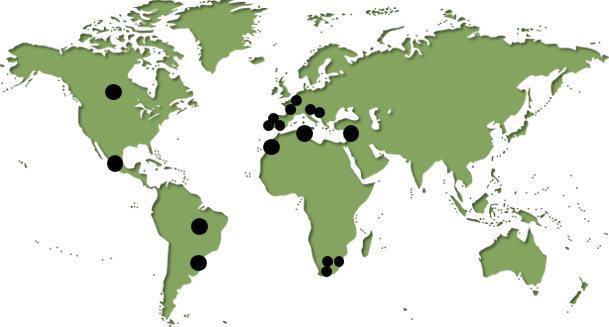
Thank you to all our contributors. The 14 male and 16 female authors from 15 countries have written 17 articles in 6 languages… Productive exchanges have allowed us to engage with them. Sometimes the conversations and debates took place between the authors themselves.
Thank you also to those we called upon to help. To assist with translation, to ensure wider dissemination. To manage technical, and sometimes legal, aspects. In particular, Javiera Atenas and Víctor Gonzaléz Catalayud for the Spanish versions, and Mary Lavissière for navigating the complexities of translating legal terms into French.
Above all, it must be said that behind the “we” are Solenn Gillouard for the UNOE blog, Erwan Louërat for the EUniWell blog and Lucie Grasset for the RELIA Chair blog.
Each of these blogs has its own editorial policy, but all three share a keen interest in the subject. This year, we have chosen to publish in French on the RELIA blog and in the various languages available on the multilingual blogs of UNOE and EUniWell. However, for an undertaking of this magnitude, it was essential to work as a team and to be able to support one another when necessary.
Finally, thank you to Ahmed Galai, who did us the honour of opening the series with a poetic article on the strong connection to sharing that every teacher has. A Nobel laureate to set the tone!
Some technical details
The objective of publishing each article in at least three languages has been achieved. Systematically, with the help of AI (DeepL Pro), we produced working versions in English, French and Spanish. We were then able to benefit from careful proofreading by one another. This remains, however, a tricky exercise: in some cases, the technical terms used (and in particular legal terms) could still be improved.
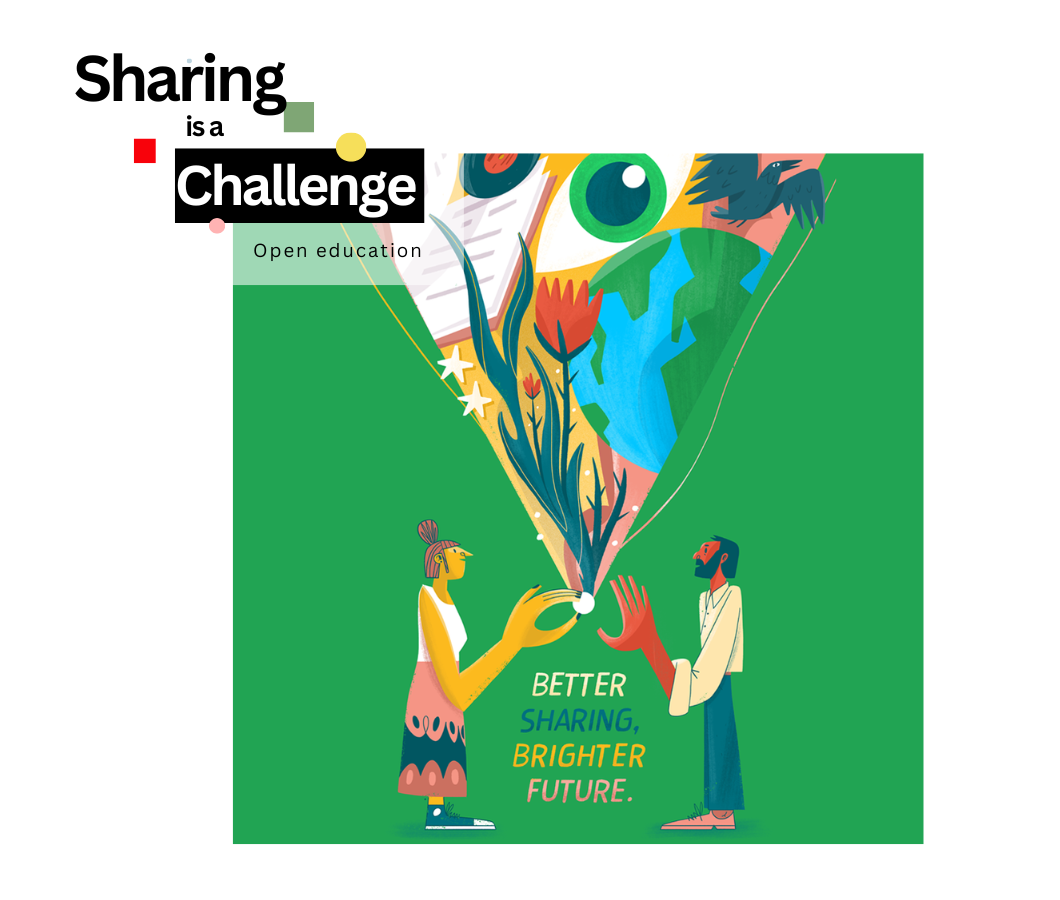
We have, of course, paid close attention to the issue of image licences, systematically choosing royalty-free images. In this regard, we would also like to thank the platform The Greats – Fine Acts, as well as the artists who share their works there under a CC BY-NC-SA licence, and who have enabled us to illustrate each of the articles in this series.
We have also had to address the issue of AI-generated images. Following Rory McGreal’s sound advice (see the article on legality), these images should be considered to be in the public domain. However, we did not dare to systematically cross the Rubicon by applying a CC0 licence to them.
What have we learnt?
In reality, we have above all been reassured by the validity of our model. As last year, we invited a large number of experts to bid for topics once the list was shared. And as last year, the topics – which were initially obstacles – were snapped up very quickly. The opportunity to co-author with writers who didn’t necessarily know each other led to transatlantic collaborations.
Our friends at Open Education Global suggested we open up the call for contributions. It was a bit frustrating not to do so, to only reach out to people we already knew. But we had already anticipated that we would sometimes need to discuss matters with the authors and ask them to go the extra mile.
The solution to being among those invited in 2027? Perhaps to submit an article for the blog in the coming months…
We have continued to explore multilingualism. We have also found that this format suits not only readers but also authors: a key rule is that everyone has the right to write in their own language. This is a controversial issue: many believe there is a lingua franca and that everyone should be able to express themselves in that language. With the help of AI, perhaps. At the Chair, we don’t see things that way, and this year we had a case where an article was first written in English, then, at our request, rewritten in the authors’ own language – and was far better in its second version.
We also broke new ground this year by offering a bilingual newsletter which people could subscribe to throughout the campaign to receive an email whenever an article was published. We had over fifty subscribers!
We also learnt (or relearned) that there would be plenty of technical glitches. Towards the end of the month, faced with repeated attacks on our servers, I even considered that this might be proof of our campaign’s success. But beyond (such conspiracy theories), we must thank Séverine Rubin, from LS2N, for her patience and her availability even at ungodly hours. [A golden rule is that servers always crash more easily outside working hours]
But what else have we learnt?
First of all, and this comes as no surprise, that the Open Education community is rich in ideas, analyses and research. By framing our topics this year in the form of sixteen keywords, one per obstacle, we thought we had staked our claim and anticipated every possibility. In reality, our authors have greatly enriched the original ideas we had imagined.
We were also reassured by the importance that must be placed on research. The word “sharing” has been around for a long time and has often been associated with the issue of OER. One can read articles dating back some twenty years in which certain difficulties mentioned here have already been analysed. One might therefore have thought that we were revisiting familiar questions with well-explored answers. This is not the case: the 2026 analyses are based on recent findings, on today’s technologies, and on the new tools that have emerged in recent years.
We note, however, that a substantial proportion of the bibliography is in English. We see this (in France) as a challenge: do we, today, have enough researchers examining the issues raised by open education in French? The answer is clearly no. That is why, in 2026, we launched a series of French-language webinars. In fact, there is one tomorrow!
The sixteen articles presented cover many shared topics. The angles are different, and the references will depend on local contexts, but several key topics are addressed.es références vont dépendre des contextes locaux, mais quelques sujets forts sont traités.
The question of recognition
Souhad Shlaka has analysed the difficulty of reconciling sharing and competition. At her university, as at so many others, competition is encouraged and, naturally, hinders sharing. She offers us the beginnings of a solution. May the institutions listen to her!
Some of these recognition mechanisms are analysed by Luc Massou (on the theme of gratitude). For him, the sharing of research is centrifugal, whilst the mechanisms for sharing educational resources are centripetal. We must therefore acknowledge that we do not express gratitude in the same way for these forms of sharing.
Javiera Atenas et Leo Havemann came up with a title that greatly intrigued readers: they started from the observation that academics were happy to share their research findings, but far less so their lectures. Like others, they call for a paradigm shift to enable academics to truly benefit from sharing.
The optimistic articles
Some have chosen to share as an act of faith. This is the case with Marcela Morales ho confirms that we are, of course, all fully entitled to share. It is also the case with Zoltan Lantos in his response to the challenge of reciprocity, in which he tells the story of one of his OERs. It seems to come to life… and thus, of course, to become emancipated. Behind his account, we sense the question we will inevitably have to address one day: how can an open educational resource, intimately associated with an author (or authors), become a digital commons in the sense of the Dubai Declaration.
It is also optimism that drives Pierre-Antoine Gourraud to share, and who tells us: The real danger? It’s not plundering. It’s waste. Alan Levine has chosen the obstacle of ingratitude but instead sends us a message of gratitude, noting that even though people who take his photos can do so without saying a word, they often choose to thank him.
The North and the South
The South is well represented among our authors. And whilst the problems are sometimes the same as those found in Europe or North America, this is not always the case.
The theme of the necessary decolonisation of knowledge is analysed without complacency by Mpine Makoe, Darrion Letendre et Robert Lawson… It could also have been at the heart of the issue of discoverability: but Benedetta Calonaci et Alessandra Gammino chose a different angle, that of information specialists and librarians.
OER is better when working as a team
But perhaps the main lesson from this series is that the collective must come first. Designing and disseminating an Open Access publication can no longer, in 2026, be the task of a single, isolated colleague. We must work together, in networks, by establishing the necessary infrastructure. This is, of course, the message conveyed by Sophie Depoterre, José-Miguel Escobar-Zuniga, Paul Lyonnaz et Nadia Villeneuve, who in Leuven, Laval, Nantes and Sherbrooke are currently building the tools that enable the collective to express itself. It is also the underlying model in South Africa and promoted by Dorothy Laubscher in her article responding to the challenge of naivety. For Barbara Class, Henrietta Carbonel et Mathilde Panes, it is in order to tackle technical challenges that we must organise ourselves and systematise our approach.
Virginia Rodés et Regina Motz remind us of something essential: “OERs have transformed access to knowledge and remain essential in a world where millions of students still lack affordable and reliable learning materials.” Their article is a conversation between two teachers.
Latifa Chahbi, Loubna Terhaz, Khalid Berrada et Alan Levine remind us that the fear of judgement by others has always been an obstacle to sharing. In their article, they draw on Michel Foucault to analyse this difficulty. But for them, open education can transform perceptions by contextualising each educational experience and providing safe environments for sharing.
The issue of artificial intelligence was addressed in two articles. By Rory McGreal to analyse the question of rights and legitimacy, and by Fawzi Baroud et Mitja Jermol to tell us that we must absolutely continue to share, despite AI (the question raised was that of its usefulness). Precisely because of AI. These articles were widely shared: it is clear that the issue of AI is of great interest. We believe and hope that these articles provide very positive answers!
Finally, many articles highlight the importance of the institution. An institution that supports through recognition mechanisms, that establishes support structures, and that promotes open education is becoming indispensable.
Let’s share
An initiative on sharing… is meant to be shared.
Nantes University has done it: as was highlighted at the launch of Open Education Month, the issue of Open Education now defines the identity of Nantes U. And the Fabrique REL is the kind of organisation that will play a key role in building the sharing tools of the future.
UNOE (UNITWIN Network in Open Education) has now found a firm place at UNESCO. The network is expanding; its policy statements and various initiatives enable us to work on a global scale.
EUniWell has just established an Open Education Observatory: this small scientific committee aims to provide a better analysis of the links between open education and well-being.
And the initiative has been taken up and promoted by UNESCO, the ICDE, the Ministry of Higher Education and, of course, Open Education Global and the Francophone consortium of Open Education Month…
Finally, the entire editorial team would like to thank our readers. Without you, ultimately, all of this would be of little interest: in sharing, both parties have a role to play.
This article is part of the series “Sharing is a challenge”, published throughout March 2026, in collaboration with the UNESCO RELIA Chair and the Euniwell Network.
Translation: This article has been written in French. This translation, produced using automatic tools and then proofread by our team, may contain inaccuracies. Please report any errors to us.
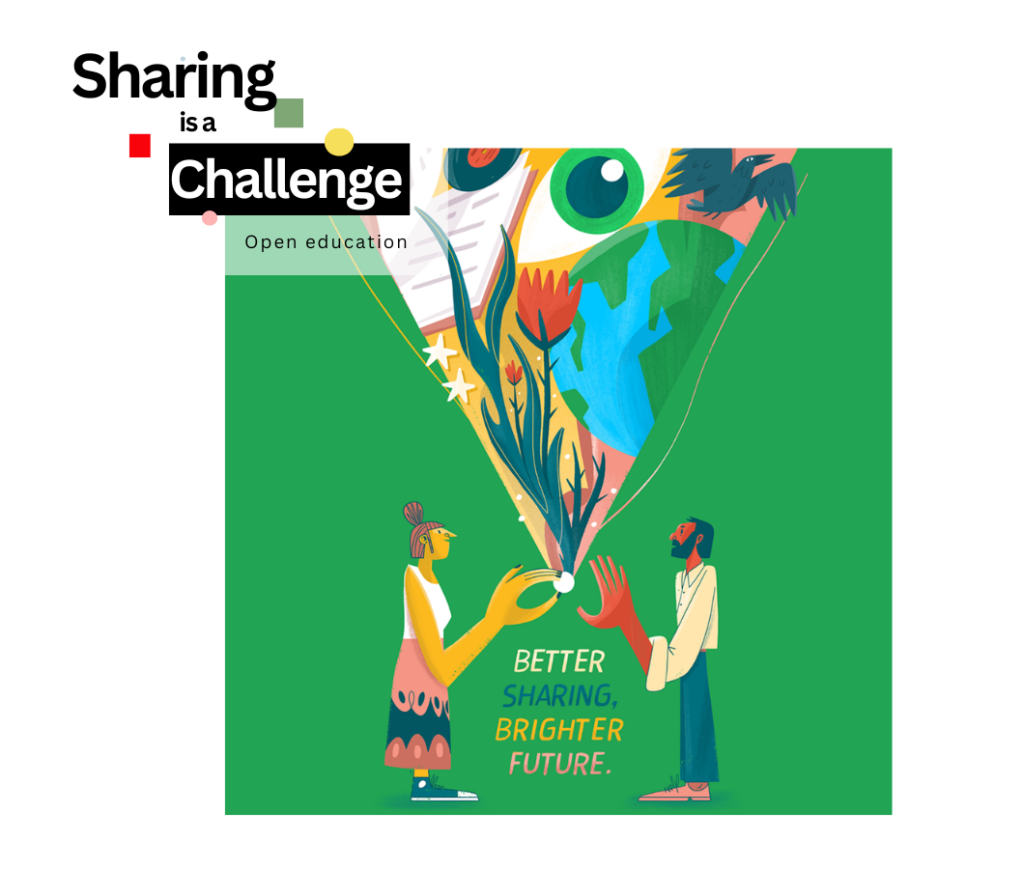
The original artistic intention remains that of the artist and can be different from the editorial intention of our remix. We thank David Espinosa for sharing his work under an open licence CC BY-NC-SA 4.0.