


Dorothy Laubscher is a professor in the Research Unit Self-Directed Learning, in the Faculty of Education at the North-West University. She holds the UNESCO Chair on Multimodal Learning and Open Educational Resources at the North-West University in South Africa. She is involved in various projects that explore open educational resources, open educational practices, mathematics teacher education, technology-supported learning and multimodal learning to promote self-directed learning.
Sharing sounds simple.
Someone posts a message in a WhatsApp group or a Teams channel: “Please share your resources.” The idea is generous and in principle, it should make teaching easier and learning better. Yet I have learned that sharing is often naïve, not because openness is a bad idea, but because we underestimate what sharing really costs. UNESCO’s Recommendation on Open Educational Resources (OER) makes this point clearly: sharing works best when it is supported by capacity building and enabling conditions (UNESCO, 2019).
In many educational communities, it is always the same people who share. You can almost predict the names that will respond when someone asks for a task, a memo, a rubric or a set of slides aligned to the curriculum. A few colleagues upload quickly, but what they share is rarely “quick”. They tidy the resource, fix errors, add instructions and adapt it so it can travel beyond one classroom. After this, often the thread goes quiet. Many download, few reply and even fewer contribute something of their own. Over time, that silence can leave contributors feeling a little used, especially when requests for more material keep coming.
It would be easy to blame individuals and call it selfishness. I do not think that is fair. Most facilitators are stretched, often exhausted and sometimes unsure whether what they have is worth sharing. The deeper challenge is naivety about what sharing requires and what happens when we expect it to run on goodwill alone.
The first naïve assumption is that sharing is effortless.
Anyone who has prepared a resource for others knows it takes time and judgement: you check the content, remove student names, clarify instructions, add a memo and make sure the file opens on different devices. You might convert it into an editable format or compress it to accommodate lower data usage. What looks like a small act from the outside is usually the final step after a long process, done in the gaps between marking and meetings.
The second naïve assumption is that sharing is free.
In South Africa, it can be expensive in small, steady ways. Data costs are a reality, and connectivity varies for different people. These challenges can interrupt the simplest tasks, including uploading, downloading or replying. When we say “just send the link”, we forget that a link is only useful if people can open it.
The third naïve assumption is that sharing is safe.
Many facilitators fear being judged, especially where feedback is not always kind. Sharing can feel like placing your work on display, and some people do not contribute because they would rather avoid criticism than risk embarrassment.
There is also a legal naivety that makes people cautious.
Many assume that if something is for teaching, it is automatically allowed to be shared. Copyright does not disappear in education, and uncertainty about permissions and licences can lead to risky sharing on the one hand or silence on the other. The Cape Town Open Education Declaration reminded us years ago that openness is not only about access to materials, but also about building a culture of participation and sharing (Cape Town Open Education Declaration, 2007).
Another assumption that is not always true, is equal access.
A video link or a large slide deck may be easy for one colleague to use and impossible for another, and the same applies to students. When we ignore unequal access, “sharing” can end up benefiting those who are already resourced. All of these forms of naivety feed the belief that reciprocity will simply happen. We imagine that if a few people model sharing, the rest will naturally join in. But without norms, recognition and a sense that contribution is safe, many people remain consumers because it is easier and less risky. The result is that the same people keep giving.
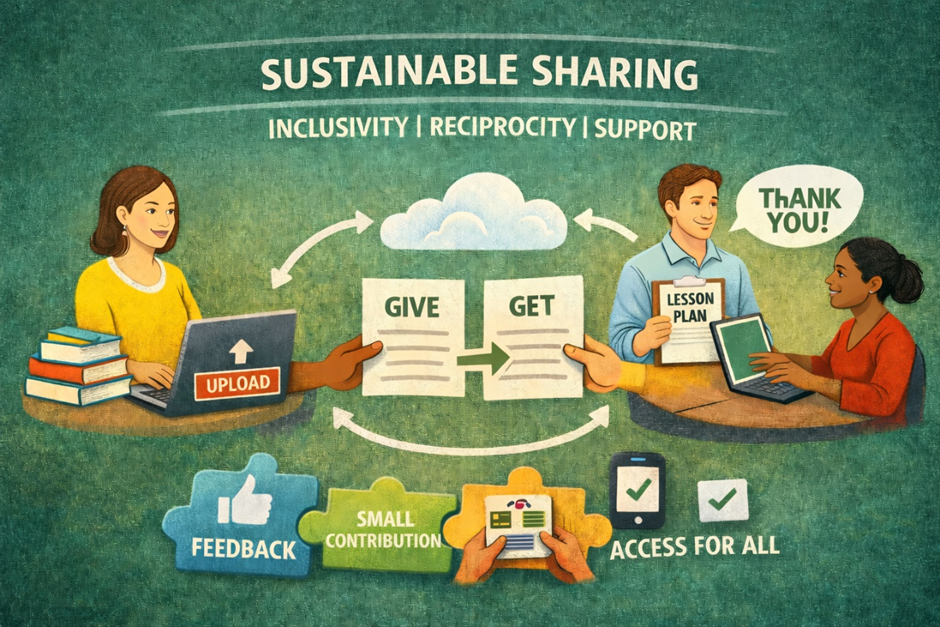
So what does a less naïve approach look like?
- It starts with a mindset change. Sharing is a collective responsibility, not the unpaid labour of a few enthusiasts. Once we accept that, we can build practices that make sharing sustainable rather than exclusive. One practical step is to make contributions visible and valued. This can be as simple as acknowledging contributors, keeping a shared folder that clearly credits authors and celebrating “small shares” such as a memo, a worked example or a short reflection on what worked in class.
- A second step is to normalise reciprocity in a friendly, realistic way. If you download a resource and it helps, respond with a short note. If you adapt it, share the adapted version back. If you cannot produce a full lesson, contribute a small piece, a rubric, a translation of instructions, a simplified low-data version or a set of alternative examples. When contribution is framed as small and doable, more people might participate.
- A third step is to reduce the pressure of perfection. A sustainable sharing culture can grow over time through the iteration of drafts, different versions and improvements. If the community makes space for “good enough” resources, shared with context and the option to refine them, more people will share, and the quality will improve through collective effort.
- Finally, design for local realities. In South Africa, smaller files, editable formats, phone-friendly documents and printable options are best suited to our context. Clear instructions help others use what you share without guessing, and thoughtful localisation makes sharing more inclusive.
The challenge of sharing is real, and naïve approaches will keep reproducing the same pattern: a faithful few giving while many quietly take. The good news is that this is not permanent. The trend can change when we recognise contributions, reduce fear, build basic licensing confidence and normalise reciprocity. So, here is my invitation. If you have been a silent downloader, become a visible participant. Offer feedback, share one thing back, even if it is small, and credit the people whose work helped you. If you lead a team or a community, create the conditions that make sharing fair, safe and sustainable. Sharing is a practice we should build. In South Africa and worldwide, where the constraints are real, our openness cannot afford to be naïve. It needs to be intentional, equitable and shared.
———-
References
Cape Town Open Education Declaration. (2007). Cape Town Open Education Declaration: Unlocking the promise of open educational resources. https://www.capetowndeclaration.org/read/
UNESCO. (2019). Recommendation on Open Educational Resources (OER). Paris: UNESCO. Retrieved 4 February 2026, from https://unesdoc.unesco.org/ark:/48223/pf0000383205
———-
This article is part of the series “Sharing is a challenge”, published throughout March 2026, in collaboration with the UNESCO RELIA Chair and the Euniwell Network.
Newsletter. To receive the upcoming articles from this series by mail, subscribe to our newsletter.
The original artistic intention remains that of the artist and can be different from the editorial intention of our remix. We thank Ana Filipa dos Santos Lopes for sharing her work under an open license CC BY-NC-SA 4.0.