Category: Misc.

  • Ako: A Maori approach in revisiting open education. Lessons learnt from the 2025 ICDE Global conference.

    Ako: A Maori approach in revisiting open education. Lessons learnt from the 2025 ICDE Global conference.

    Several hundred participants gathered in the ICDE (International Council for Open and Distance Education) Global Conference 2025 in Wellington, Aotearoa, New Zealand on the 10-13 November 2025 to express their support of open, inclusive, scalable, sustainable online education.  This resulted from different policy‑ and practice‑oriented discussions based on ‘Ako’ the Maori concept that recognises that knowledge and understandings can grow out of shared learning experiences.  This concept resonates with “Ubuntu” (I am because we are), a Southern African philosophy of interconnectedness and shared humanity.  In this conference, ‘Ako’ was used as a guiding lens for designing inclusive, scalable, and sustainable education, with explicit strands on accessibility and resilience, context and quality, indigeneity, innovation, open education resources and (OERs) and open practices.

    The conference theme, “Ako: Exchanging ideas for inclusive, scalable, and sustainable education,” focussed on reducing barriers to access, ensuring cultural and geographical equity, and navigating tensions between digital scale, funding constraints, and equitable learner support, with an emphasis on the impacts of AI in education. A recurring thread throughout the conference was the importance of human values and care in a technology driven education system.  Other prominent focal points included educational leadership, and mutual enrichment in teaching and learning, open and online learning in enabling scale and challenging learner support and cultural responsiveness.  In addition, the conference hosted several workshops including the ICDE Global Doctoral Consortium which brought together students from across the globe to share their work in progress among peers and experts while forming strong networks that survives beyond the conference. 

    Conference speakers that included policymakers in open, distance, and digital education from over 50 countries, noted the need to develop mechanisms for enabling local initiatives without undermining quality or cultural fit.  Some presenters stressed the danger of treating AI as a neutral or universal tool. Therefore, institutions should move beyond technocentric models and build ecologies of care that honour diverse knowledge systems and advance social and epistemic justice.  There is a growing consensus that AI policies must be clear, contextual, and co-developed with students. Speakers also expressed the need to treat students as knowledge co-creators by designing of study material and assessment rubrics, test prompts, and even AI-use declarations, turning policy into pedagogy.  

    They argued that an inclusive education must be rooted in relationality, advancing equity with a purpose of the future that ensures that no one is left behind. This ICDE conference supported a stronger integration of indigenous perspectives into global discourse on open and distance education, positioning Ako as a model for reciprocal, culturally grounded practice.


    Image by Cecilia Castelli.
    Https://thegreats.co/artworks/unity-is-my-community.
    Published under Creative Commons-Attribution-NonCommercial-ShareAlike 4.0 International license (CC-BY-NC-SA).

    Ako: A Maori approach in revisiting open education. Lessons learnt from the 2025 ICDE Global conference.

    ” by Mpine Makoe & Rory McGreal is licensed under CC BY 4.0

  • Open Education Principles: Resisting the Metrics of AI Black Boxes

    Open Education Principles: Resisting the Metrics of AI Black Boxes

    Discover this insightful article co-authored by three members of the UNOE network: Tel Amiel (Universidade de Brasília), Glenda Cox (University of Cape Town, South Africa) and Colin de la Higuera (Nantes Université, France).

    In the article, published by UNESCO, the authors explore how open education principles can serve as a counterbalance to the growing dominance of metrics and market-driven models in education.

  • The UNITWIN Network on Open Education proposes to adopt an open dissemination policy for all UNESCO Chairs and UNITWIN Networks.

    The UNITWIN Network on Open Education proposes to adopt an open dissemination policy for all UNESCO Chairs and UNITWIN Networks.

    The UNITWIN Network on Open Education (UNOE) is one of the initiatives by UNESCO with the aim to contribute to the Open Education Agenda. Launched in June 2024, this global network convenes UNESCO Chairs and partners, in all regions of the world, working on Open Education.

    The UNOE values the importance of the UNITWIN/UNESCO Chairs programme – established 30+ years ago, with the aim to foster inter-university collaboration and enhance institutional capacities through knowledge sharing and collaborative research initiatives. 

    To help achieve its mission, UNOE is convinced of the necessity to share courses, resources, data and findings of the UNESCO Chairs and UNITWIN Networks openly. 

    UNESCO Chairs are entities where knowledge is created, collected and curated. In line with the 2019 Recommendation on Open Educational Resources and the 2021 Recommendation on Open Science, when UNESCO Chairs disseminate this knowledge, they have a specific responsibility: to make it available, openly and freely, to all.

    On the first day of the third OER Congress in Dubai, we the UNOE Network, are proposing that dissemination of research articles and other written materials from the UNITWIN/UNESCO Chairs Programme members are systematically released as Open Access, and educational materials as Open Educational Resources. We propose that UNESCO makes this a policy.

    If UNESCO adopts this idea, UNOE, the Unitwin Network on Open Education, will provide its support by sharing material, running webinars and assisting all UNESCO chairs in transforming their practices.

  • UNOE promotes a text in favour of OER at the 3rd UNESCO World Congress

    UNOE promotes a text in favour of OER at the 3rd UNESCO World Congress

    The third OER World Congress was held in Dubai on 19 and 20 November 2024.

    The first one took place in Paris in 2010 and enabled UNESCO to take a position on the issue of OER. In 2017, in Ljubljana, the Congress launched the process leading to the adoption of the UNESCO recommendation in 2019. Seven years on, the initial ambition is to analyze the current situation and come up with a declaration (known as the “Dubai Declaration”) strongly affirming the values of open education.

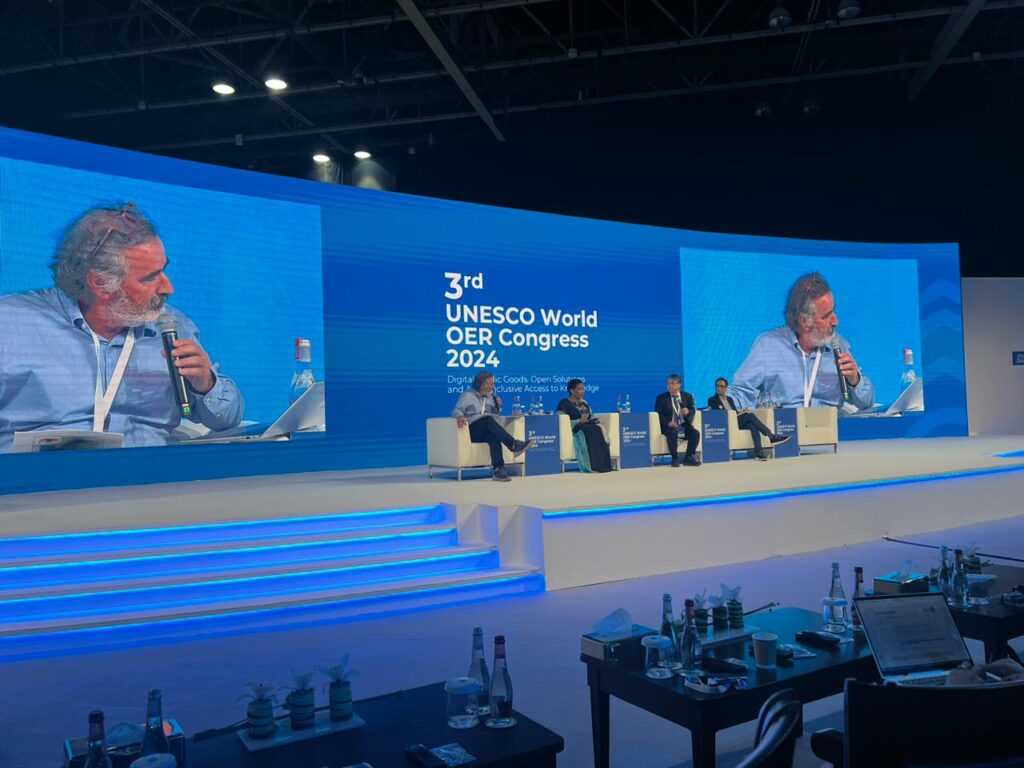
    The first day of this type of event is very formal. The ministers have the floor at UNESCO (from 10:00), to present what has been achieved since 2019. I have been invited to moderate a session on the links between artificial intelligence and open educational resources, with particular reference to digital inclusion (from 2:30).
    Dr Phumzile Mlambo-Ngcuka is a former Minister and Deputy Prime Minister of South Africa. She talks to us about gender issues, noting how AI and OER, because they allow a degree of flexibility, are able to contribute to the educational issues of women and girls.
    Mr Seizo Onoe, from the International Telecommunications Union (ITU), aimed at convincing us of the benefits of standardisation: the ITU plays an essential role in network access.
    Mr Kevin Chan is director for Global Policy Campaign Strategies at Meta. He spoke in favour of open LLMs: he believes that these are the models that should be favoured. This raises the question of “virtuous” chatbots and virtual assistants that are as open as possible.

    As moderator of the round table, I was able to gauge the number of essential subjects that need to be addressed when looking at the issues of open education and artificial intelligence together. I was also able to use my ‘right to conclude’ to make a proposal on behalf of the UNITWIN UNOE network that we coordinate from Nantes.

    Session on AI, OER and inequalities – photography under CC0 licence

    Curiously enough, while UNESCO is asking Member States to apply the 2019 recommendation, and while it systematically publishes its own reports under a Creative Commons licence, there are no rules for the 1,000 or so UNESCO Chairs and 100 UNITWIN networks.

    I have therefore proposed, on behalf of the UNOE network, that publishing openly should become the rule. The text of the proposal can be found here. Initial feedback from the major international OER players and UNESCO is already very positive. We will, of course, publish the results on this blog.

    Licence

    Unless otherwise indicated, all content on this site is made available under the terms of the Creative Commons Attribution 4.0 International Licence.

  • UNOE or the University of the Future

    UNOE or the University of the Future

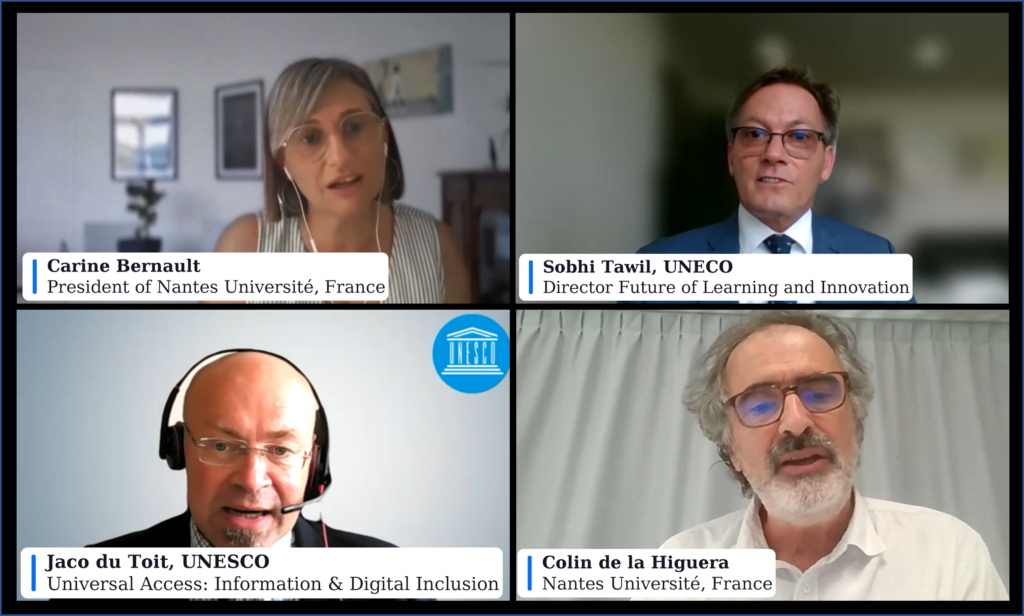
    On Wednesday 26 June 2024, we launched the Unitwin UNOE open education network.

    The inauguration took place online, and the event can be viewed or replayed here: https://mediaserver.univ-nantes.fr/videos/lancement-reseau-unitwin-unoe/.

    A global network

    Participants from over 35 different countries logged on to attend the network launch and listen to the experts talk about open education.

    Beyond the figures, this global perspective means that we can think globally rather than just (!) nationally. With this horizon (or rather absence of a horizon), perspectives necessarily change.

    The University of tomorrow will be open and built with young people

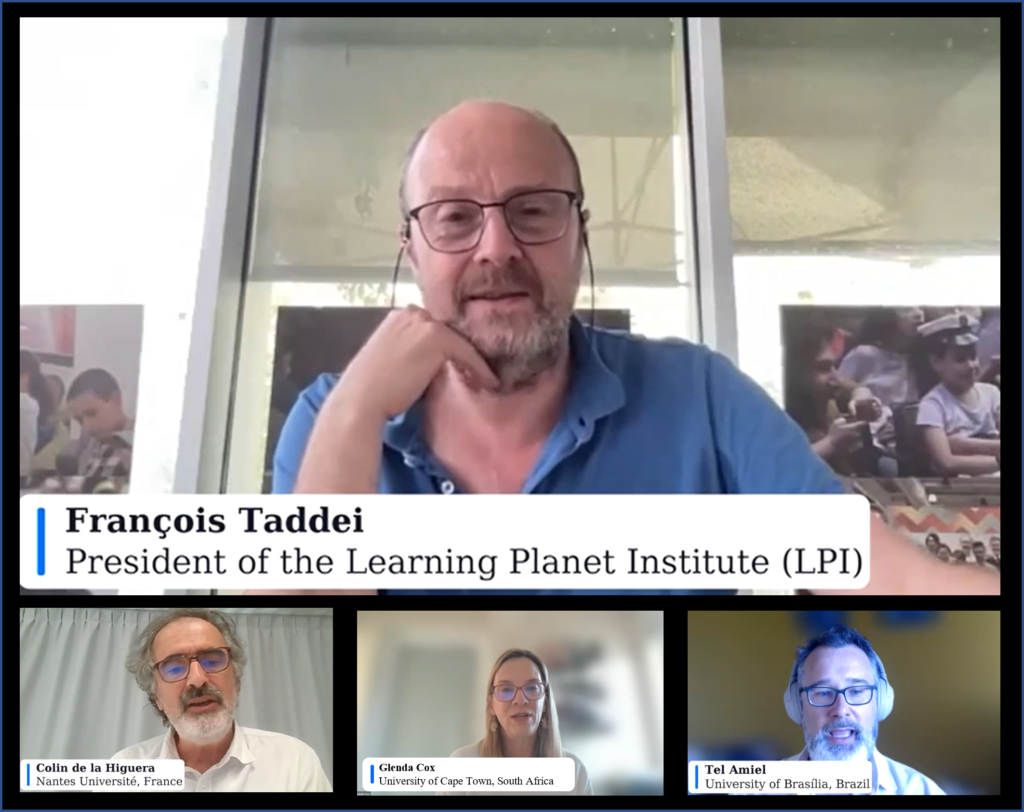
    This was the main message from François Taddei, our guest speaker: in order to take into account both the natural commons and the digital commons that we are creating, we need to involve young people in the thinking and co-construction of the University of the future.

    Open education beyond Open Educational Resources

    OER have long been the main instrument of open education. And thinking about OER has often revolved around the issue of licensing. In practice, a course on OER will always go through this. But the future of open education – particularly under the influence of artificial intelligence – depends on much more than this question of licences!

    What we learned from the launch

    The inauguration means that the network now exists. Its success shows that while reflection can take place locally, it must also take into account our histories, our differences and above all our common needs.

    In UNOE, we are working along these lines. But we can do much better when it comes to including young people in our thinking. We’ll need to launch initiatives along these lines as early as September!

    A few testimonials

    “Greetings from Ministry of Higher Education and Research in France, which actually work on a national strategy about Open Education, with many experts and partners like Nantes University and Unesco Chair RELIA coordinated by Colin. Congratulation for this very interesting international initiative !”

    “Grateful to be part of this important initiative. Excited for the rich collaborations ahead. A thank you from Notre Dame University Louaize – Lebanon.”

    “Thank you for a really inspiring and interesting conversation. We really look forward to following the network from the ICDE network.”

    “The great organisation effort is now evident with a wonderful session today. Congratulations, a lot of learning for all of us on a critical issue. Open solution. Thank you.”

    “This Initiative allows for high level borderless commitment to configure open solutions as public goods. It will be important to set priority actions for us to undertake towards this common endeavor.”

    “Today I had the great pleasure of attending the inauguration and launch of the UNITWIN Network Open Education_UNOE under the auspices of Nantes Université & Unesco.
     For me, this was one of the highlights of the year.
     Finally, someone who dares to change the OE Agenda and its narratives.
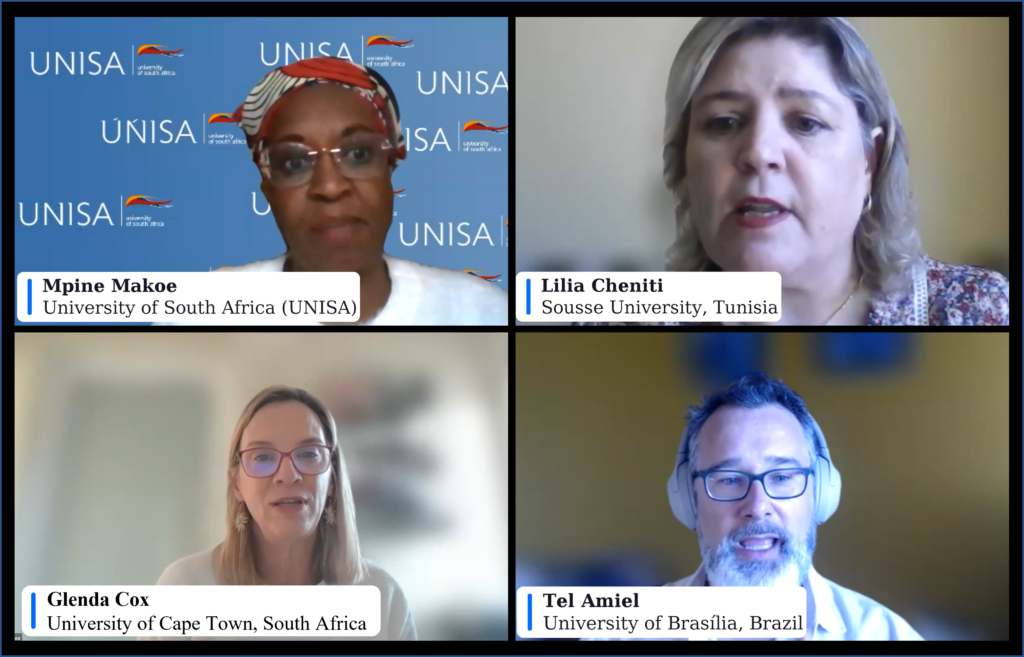
    Thanks also to Cheniti Lilia who was one of the panelists also to @Mpine one of our previous OERAC Ambassadors, now on ICDE Board for your contributions.
    Mr Taddei talked about Planetism and Planetlsts, a very interesting concept, and also about including all learners and diversity in the OE Agenda, and the new social contract.”

    And finally, a few screenshots