


Sophie Depoterre – Academic Advisor – Louvain Learning Lab, UCLouvain
José-Miguel Escobar-Zuniga – Librarian, Université de Sherbrooke
Paul Lyonnaz – Open Education Advisor, Nantes Université
Nadia Villeneuve – Coordinator of the Quebec OER Hub, Librarian responsible for Open Education, ULaval
The creation and sharing of open educational resources (OER) are often perceived as time-consuming. In the context of higher education, we seek to answer the following questions: is this perception accurate, false or incomplete? And above all, what conditions are needed to ensure we have the time required to create or adapt the educational resources we wish to make available to everyone?

OER or DER: an introduction
There is often confusion between OER and digital educational resources (DER), hence the need to start by defining them. According to the definition proposed by UNESCO (2021), open educational resources (OER) encompass all materials used for learning, teaching or research purposes, regardless of their format or medium. These resources are either in the public domain or subject to copyright and are therefore made available under an open licence permitting their use, adaptation and distribution.
A DER is not necessarily open, as it does not always grant the permissions for modification, reuse or distribution that characterise OERs. Although all OERs in digital format fall within the category of OERs, the reverse is not true (Potvin and Dubé, 2024).
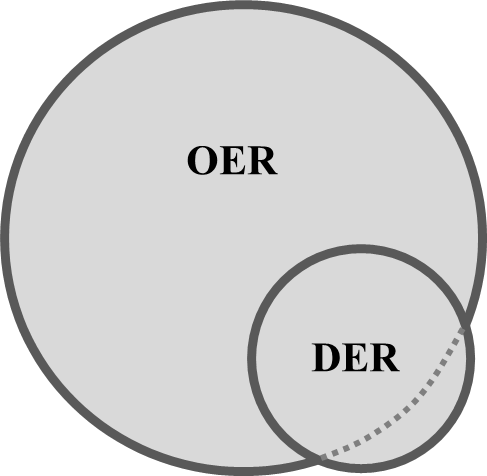
by fabriqueREL, CC BY (Potvin and Dubé, p.144, 2024) /
Translation from French to English
The transformation of DERs into OERs requires specific considerations related to the open nature of the resource. We describe these briefly below.
Searching for and reusing OER: investing time to save time
Firstly, finding open-access resources in specialised repositories and using suitable search engines can be time-consuming. That said, the ongoing development of AI tools offers the prospect of effective additional support for identifying – and adapting – OER. In any case, judicious use, respect for copyright, the protection of sensitive data and the cross-checking of generated content remain necessary. In other words, even when tools facilitate and accelerate the identification, generation and processing of content, human judgement remains indispensable.
Furthermore, the application of the terms of use – modification, commercial or non-commercial use, sharing under the same conditions – of an OER requires increased attention. Moreover, when combining several OERs, licence compatibility between them is essential. To determine which licence to apply to the derivative work, consult the Creative Commons website. The most restrictive licence takes precedence.
Let us also consider the stage of referencing the resources used. Just as with copyrighted works, the citation of OER references must be rigorous and exhaustive. However, fundamentally, this essential step is not specific to OER.
Collaboration: a dilemma in time management?
The very essence of OERs lies in co-creation, and their development often relies on interprofessional collaboration between teachers, librarians, educational advisers, multimedia technicians, etc. A large-scale project requires coordination at every stage: needs assessment, research, design, development, validation and dissemination (fabriqueREL). Whilst this diversity can sometimes prove costly in terms of coordination, it contributes significantly to the quality and dissemination of OER (Potvin and Dubé, 2024).
To optimise time management and thereby encourage a wider community to adopt open education, we have chosen to share a few points for reflection, which can be utilised either directly by OER creators or at the institutional level.
Analysis of educational needs: avoiding wasted time
Le questionnement préalable du besoin pédagogique est déterminant pour un démarrage optiCareful consideration of educational needs is crucial for an optimal start to an OER project.
- What is the intended purpose of the OER we wish to adapt or create?
- Is it a common topic, simple or complex, one that has already been covered or, conversely, a new one?
- Who is the main target audience: students, the general public or a more specific group?
- What are the educational needs of the target audience in terms of content, tools, learning methods, formats and accessibility? (Depoterre, et al., 2025)
- Are there any OERs that can be adapted to one’s own context?
A preliminary analysis of educational needs enables you to make ingenious and realistic choices when designing and sharing an OER. This step, though sometimes overlooked, is the one that saves the most time later on.
Drawing from and contributing: a virtuous cycle over time
Not reinventing the wheel or attempting to build a cathedral alone is also a fundamental principle of open education and OERs. Being more open-minded may require a shift in perspective and approach to one’s project, and may even seem counterproductive at first, but it helps to optimise design time.
And what if, as well as changing your approach, you adopted a collaborative and iterative mindset? Why not publish a functional version without aiming for completion or perfection, share modular components rather than a complete system, and improve the resource later if necessary? This approach embodies the very spirit of open education (Wiley, 2017; UNESCO, 2021). Adopting a mindset of continuous contribution transforms the creation of OER into a living and sustainable process.
Indeed, early sharing reduces the time invested at the outset, enables a quicker response to identified needs and shifts part of the improvement effort to the user community. Support from peers or the open community facilitates this sharing. Networking opens up opportunities for exchange and generates shared learning through professional co-development. Through “collaboration and interconnection with colleagues”, “additional resources” are created and, reciprocally, professional value is generated in the act of sharing (Mollenhauer, 2023). This is a form of collective intelligence applied to OER.
Open pedagogy: ingenuity, agility and time savings
The involvement of learners in the co-creation process, within open pedagogy (Roy et al., 2023), also helps to maximise the time invested. Pooling their learning needs and their mastery of design tools can prove useful and contribute to the quality and distribution of the OER. And this is often where projects gain unexpected momentum.
Beyond the actions that can be directly undertaken by those creating OER, institutional initiatives or arrangements can also help to optimise the time taken to produce OER.
A supportive and enabling environment
Supporting the development of skills among OER creators is a key factor. To support this growth in autonomy and skills, it is crucial to provide specific training opportunities.
Providing an appropriate digital environment, including reliable platforms, access to document resource banks compatible with OER, and responsible artificial intelligence tools, provides concrete support for the creation and adaptation of OER. These technologies facilitate the exploration, enrichment and transformation of content, making it easier to develop high-quality resources tailored to learners’ needs.
Collaboration between institutions and their constituent parts at local, national or international level acts as a powerful catalyst. This frees up shared time where we did not think any was available.
Finally, adopting an open education policy enables the provision of a clear, coherent, empowering and sustainable environment. This policy offers a framework conducive to innovation, the dissemination of knowledge and the promotion of open initiatives.
Training, supporting, collaborating and recognising: four institutional levers that make all the difference for open education and the creation of OER.
Is sharing OER really time-consuming?
To conclude, the perception that sharing an OER is time-consuming is partly justified by certain tasks specific to the open nature of the resource. But to say that OERs take time without naming the elements that save time is to miss the point!
OERs are rarely created in isolation. Their life cycle — creation, adaptation, reuse, improvement — is naturally marked by contributions from many hands. Everyone adds a brick, then another, sometimes years later. The result: a shared, open, evolving and sustainable heritage that supports lifelong learning. This is undoubtedly the greatest secret of OER: it is bigger than us, it transcends us and brings us together.
Essentially, promoting OER and developing a culture of sharing means promoting a vision of education where knowledge flows freely.
—–
References :
Depoterre, S., Fromentin, J. & Louette, F. (2025). Les Clés du LLL. Open Education. Enrichir ses cours grâce aux ressources éducatives libres. http://hdl.handle.net/20.500.12279/1132
fabriqueREL. Le parcours de création. https://fabriquerel.org/processus-de-creation/
Mollenhauer, L. (2023). Conditions pour l’utilisation réussie des ressources éducatives libres (REL). EP Revue suisse pour la formation continue, (2). https://www.ep-web.ch/fr/article/conditions-pour-lutilisation-reussie-des-ressources-educatives-libres-rel
United Nations Educational, Scientific and Cultural Organisation (UNESCO). (2021). Open Educational Resources. https://www.unesco.org/fr/open-educational-resources
Potvin, C. & Dubé, M. (2024). Chapter 9. Créer des ressources éducatives libres : un parcours structurant pour une qualité optimale. Dans F. Chevalier et C. Fournier Pratiques pédagogiques innovantes : Construire la pédagogie de demain (p. 141-159). EMS Éditions. https://doi.org/10.3917/ems.cheva.2024.02.0141
Remixing CC-Licensed Work. In: Creative Commons Certificate for Educators, Academic Librarians, and Open Culture. Creative Commons. https://creativecommons.org/course/cc-cert-edu/unit-4-using-cc-licenses-and-cc-licensed-works/4-4-remixing-cc-licensed-work/
Roy, M. & al. (2023) Pédagogie ouverte. In: Éducation ouverte et ressources éducatives libres (REL). Guide en ligne du Service des bibliothèques de l’UQAM adapté de celui de l’équipe projet REL des BUQ et la fabriqueREL. https://uqam-ca.libguides.com/c.php?g=736276#s-lib-ctab-16685807-2
Wiley, D. (2017). Iterating Toward Openness: Lessons Learned on a Personal Journey’, dans R. Jhangiani and R. Biswas-Diener (éds) Open: The Philosophy and Practices that are Revolutionizing Education and Science. Ubiquity Press. https://doi.org/10.5334/bbc.o
This article is part of the series “Sharing is a challenge”, published throughout March 2026, in collaboration with the UNESCO RELIA Chair and the Euniwell Network.
Newsletter. To receive the upcoming articles from this series by mail, subscribe to our newsletter.
Translation: This article has been written in French. This translation, produced using automatic tools and then proofread by our team, may contain inaccuracies. Please report any errors to us.
L’intention artistique originale reste celle de l’artiste et peut être différente de l’intention éditoriale de notre remix. Nous remercions Kim Nguyen pour le partage de son œuvre sous licence ouverte CC BY-NC-SA 4.0.

“
Open Educational Resources: Is Sharing Really Time-Consuming?
” by Sophie Depoterre, José-Miguel Escobar-Zuniga, Paul Lyonnaz & Nadia Villeneuve is licensed under CC BY 4.0