


Khalid Berrada is a lecturer and researcher at the Faculty of Sciences of Rabat (FSR), Mohammed V University, Morocco. He is Director of the ICESCO Chair for Open Education and held a UNESCO Chair dedicated to teaching physics through practice. Involved for many years in fundamental research and educational development, he has co-authored more than a hundred scientific publications and books. He has also participated in numerous international conferences and served on various scientific committees. Very active in the design and management of projects at national and international levels, his recent work focuses mainly on science education, educational technologies, open education, active learning, as well as distance learning and open learning.
Latifa Chahbi is a senior lecturer at the Oussoul-Eddine Faculty of Abdelmalek Essaâdi University (Morocco). She is also a member of the ICESCO Chair for Open Education and the UNITWIN UNOE network. A winner of the RECOMPES programme (April 2025), her work focuses on the relationship between literature, digital technology and pedagogy. She has published several scientific articles on digital literature and interactive narrative forms.
Loubna Terhzaz is a senior lecturer at the Faculty of Sciences of Mohammed V University in Rabat, Morocco. She is a member of the ICESCO Chair for Open Education and the UNITWIN UNOE network. She also serves as Secretary General of the Averroès Foundation for the Promotion of Scientific Research, Innovation and Sustainable Development, where she is actively involved in projects related to education, research and international cooperation.
Alan Levine : Since connecting a Mac SE/30 server to the Maricopa Community College District network in 1993, Alan Levine (https://cog.dog) has been a committed advocate for the web and open education. As Director of Community Engagement at Open Education Global, he works to promote open educational practices and to highlight the generosity of teachers who freely share their resources, ideas and experiences in the service of accessible and collaborative education.
Judgement permeates all human experiences. It structures our relationships, guides our choices and profoundly influences how we perceive ourselves and others. In the field of education, it is omnipresent. Sometimes explicit, often silent, it nevertheless has a considerable impact on behaviour, speech and professional decisions. Learners’ fear of judgement is widely recognised. We know how much it inhibits speaking up, discourages mistakes and encourages conformity. On the other hand, teachers’ fear of judgement is rarely mentioned. Yet in many educational contexts, teachers hesitate, delay or refrain from sharing their teaching practices for fear of being judged by their peers, evaluated by the institution or compared to implicit standards of ‘good teaching’.
This professional silence raises questions, especially since it coexists with institutional discourse that values innovation, collaboration and sharing. Why do so many practices remain invisible? Why do so many teaching experiences remain confined to the closed space of the classroom?
1. Judgement as a universal human experience
Judgement is a fundamental human faculty. It is an act of discernment that allows us to understand, compare and make sense of what we experience. Without judgement, there would be no reflection or decision-making. In this sense, judgement is necessary and constitutive of the human experience.
However, judgement is never limited to a purely rational operation. It is always embedded in a relationship with others and in a social context. It can support and recognise, but it can also exclude and disqualify. It can open up understanding, but it can also lock people into fixed categories. The philosopher Hannah Arendt reminds us that judgement requires thinking that takes into account a plurality of viewpoints (Arendt, 1961). When this plurality disappears, judgement ceases to be an opening towards meaning and becomes an instrument of standardisation.
2. Judging and being judged: a daily reality in educational spaces
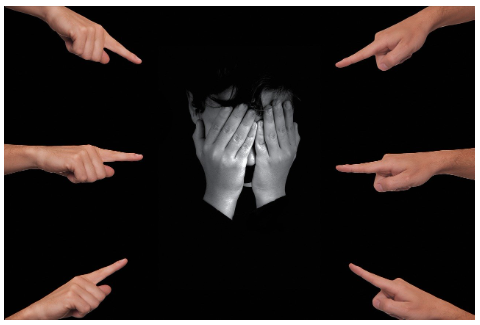
In educational settings, judgement is constant. It is exercised through grades, assessments and inspections, but also in informal exchanges between colleagues, teaching meetings and training sessions. Every teaching practice can become an object of observation, comparison or commentary.
Teachers occupy a paradoxical position. They are both the evaluators and the evaluated. Their teaching methods, their innovations or their adherence to more traditional, less practices are subject to multiple, often implicit, scrutiny.
This permanent exposure creates constant vigilance. Sharing a practice means exposing oneself. Acknowledging a difficulty means risking being perceived as less competent. Innovating means accepting to step outside the box and embrace uncertainty. Gradually, a cautious stance becomes necessary, and with it, pedagogical silence.
3. When fear of judgement stifles expression and blocks educational sharing
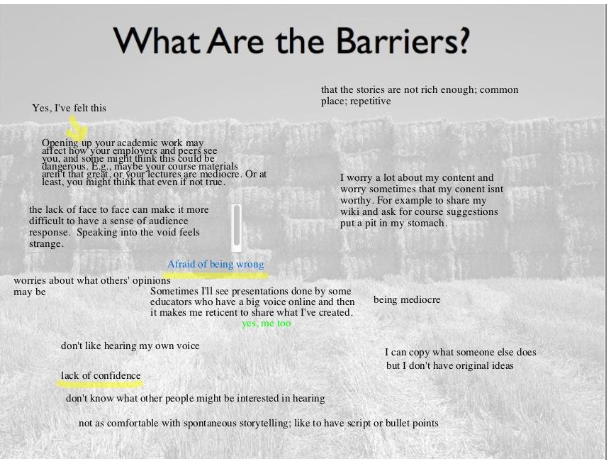
Fear of judgement rarely acts in a visible way. It does not manifest itself in open conflict, but in silence, gradual withdrawal and avoidance strategies. In educational spaces, it creates a climate where people learn to protect themselves before they even dare to express themselves. This reality was highlighted in 2013 by Alan Levine during the MOOC Educational Technology and Media MOOC (ETMOOC).
The majority of participants expressed their fear of being judged, compared or evaluated when sharing their teaching practices. The obstacles to sharing identified were less about a lack of technical skills than a symbolic insecurity linked to the gaze of others.
For many teachers, sharing teaching practices means exposing part of their professional identity: their choices, their trial and error, but also their limitations. In institutional contexts marked by evaluation and implicit comparison, this exposure is perceived as risky. The fear is not so much of being criticised as of being reduced to a label: an uninnovative, overly traditional or insufficiently rigorous teacher.
This fear is reinforced by implicit pedagogical norms. Dominant models of ‘good teaching’ circulate, often idealised, leaving little room for ordinary, situated and imperfect practices. Faced with these models, many prefer to remain silent. When spaces for sharing do exist, they present polished and accomplished practices, giving the illusion of widespread mastery, which further reinforces the fear of judgement.
Michel Foucault’s analyses shed light on this phenomenon: judgement, embedded in systems of control and standardisation, leads to the internalisation of the evaluative gaze (Foucault, 1975). This self-censorship is one of the major obstacles to pedagogical sharing.
4. The cost of pedagogical silence for teachers and learners
This professional silence does not only affect teachers. It also has direct consequences for learners. When teachers no longer dare to share, experiment or question their practices, teaching tends to become stagnant. Mistakes become less tolerated, creativity is reduced and the classroom atmosphere becomes more rigid.
The fear of judgement is then transmitted, almost imperceptibly, to learners. The educational space is transformed into a space of conformity, where the primary goal is to give the correct answer rather than to think together.
5. Open education: transforming the nature of judgement
It is in this context that open education appears as a possible response to the climate of judgement. It is not limited to digital tools or open resources. Above all, it constitutes a profound transformation of educational culture, based on trust, dialogue and collective progress.
Open education challenges the idea of an ideal and universal teaching practice. It affirms that all practices are situated, linked to a specific context, audience and constraints. This recognition of diversity helps to reduce the fear of judgement.
In concrete terms, open education transforms the nature of judgement by changing the spaces and methods of sharing. In systems such as educational blogs, open communities of practice or collaborative projects, judgement no longer focuses on conformity to a standard, but on understanding a process. Feedback takes the form of comments, questions or extensions, rather than hierarchical assessments.
From this perspective, the blog Why Do We Learn Today? Insights from Moroccan Students, produced as part of the UNOE Students Project of the ICESCO Chair(Islamic World Educational, Scientific and Cultural Organisation) on open education, is a particularly illuminating example. This initiative highlights the potential of student blogs, combined with artificial intelligence, as levers for pedagogical transformation in higher education. Designed as a collaborative learning space, this blog allows teachers and learners to share pedagogical experiments, critical reflections and sometimes even unresolved questions about open education and the uses of AI. Judgement is neither hidden nor avoided: it is explicit, reasoned and always contextualised. Contributions are not ranked or pitted against each other, but are discussed, enriched and linked together in a dynamic dialogue. The sharing of teaching practices thus becomes a collective resource, promoting mutual learning, rather than an individual risk linked to the fear of being evaluated or disqualified.
This approach is fully in line with the thinking of Paulo Freire, for whom education must be based on dialogue, conscientisation and the co-construction of knowledge, rather than on a vertical power relationship (Freire, 1970).
6. Safe spaces for authentic sharing
The safe spaces referred to in the context of open education can take many forms: peer communities of practice, open but moderated reflective blogs, collaborative non-evaluative seminars, or sharing platforms without grading or ranking. Their specificity lies not so much in their technical architecture as in the ethical rules that structure them: explicit kindness, the right to make mistakes, recognition of contexts, and suspension of normative judgement.
These spaces allow teachers to make ordinary, unfinished or experimental practices visible without fear of professional disqualification. Judgement becomes dialogical, formative and oriented towards continuous improvement.
Judgement is inevitable, but it is not immutable. When it dominates in a normative and implicit form, it isolates, blocks and impoverishes. When it is transformed, made explicit and shared, it enlightens, accompanies and helps growth.
Open education offers teachers a framework for reconciling high standards with humanity, innovation with security, judgement with recognition. By transforming the relationship with judgement, it makes possible what is still too rare in educational institutions: a sincere, regular and fruitful sharing of teaching practices, in the service of a fairer, more vibrant and truly collective education.
——-
Bibliographical references
Arendt, Hannah (1961). Between Past and Future: Eight Exercises in Political Thought. New York: Viking Press.
Foucault, Michel (1975). Discipline and Punish: The Birth of the Prison. Paris: Gallimard.
Freire, Paulo (1970). Pedagogy of the Oppressed. Paris: Maspero.
Levine, Alan (2013). What Are the Barriers? Reflections on Sharing Practice in Open Online Learning. Educational Technology and Media MOOC (ETMOOC). Online resource licensed under Creative Commons (CC BY).
——-
Collaborating Beyond Languages: Contribution Note by Alan Levine
Alan Levine was enthusiastic about contributing to this article, but found that it had already been reserved and was being written in French. As his reading skills in this language had not progressed since high school (his apologies to Mr Rivkin), he was able to communicate and collaborate with the co-authors thanks to Google Translate. A great way to overcome difficulties! – A. Levine
This article is part of the series “Sharing is a challenge”, published throughout March 2026, in collaboration with the UNESCO RELIA Chair and the Euniwell Network.
Newsletter: To receive the upcoming articles from this series by mail, subscribe to our newsletter.
Translation: This article has been written in French. This translation, produced using automatic tools and then proofread by our team, may contain inaccuracies. Please report any errors to us.
The original artistic intention remains that of the artist and can be different from the editorial intention of our remix. We thank Dumitru Ochievschi for sharing his work under an open license CC BY-NC-SA 4.0.

“
From Judgement to Sharing: Rethinking Teaching Practices in the Era of Open Education
” by Latifa Chahbi, Loubna Terhzaz, Khalid Berrada & Alan Levine is licensed under CC BY 4.0